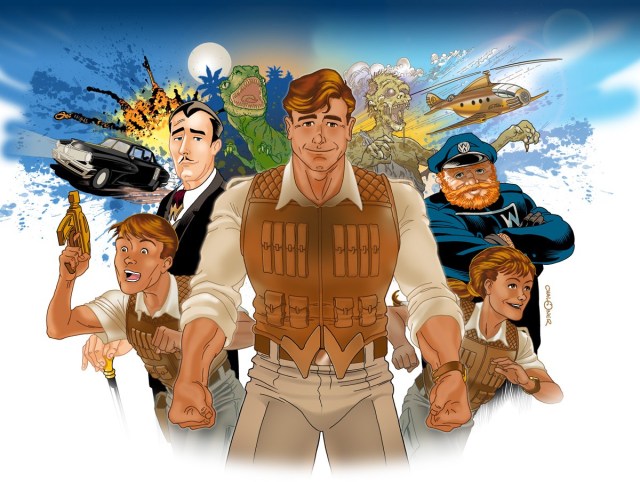
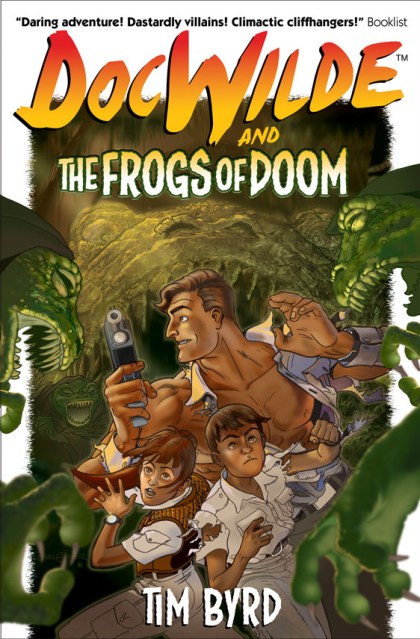
Okay, the work is done and Doc Wilde and The Frogs of Doom is on the verge of its rebirth as a much improved, fully illustrated edition. We even have the bar code.
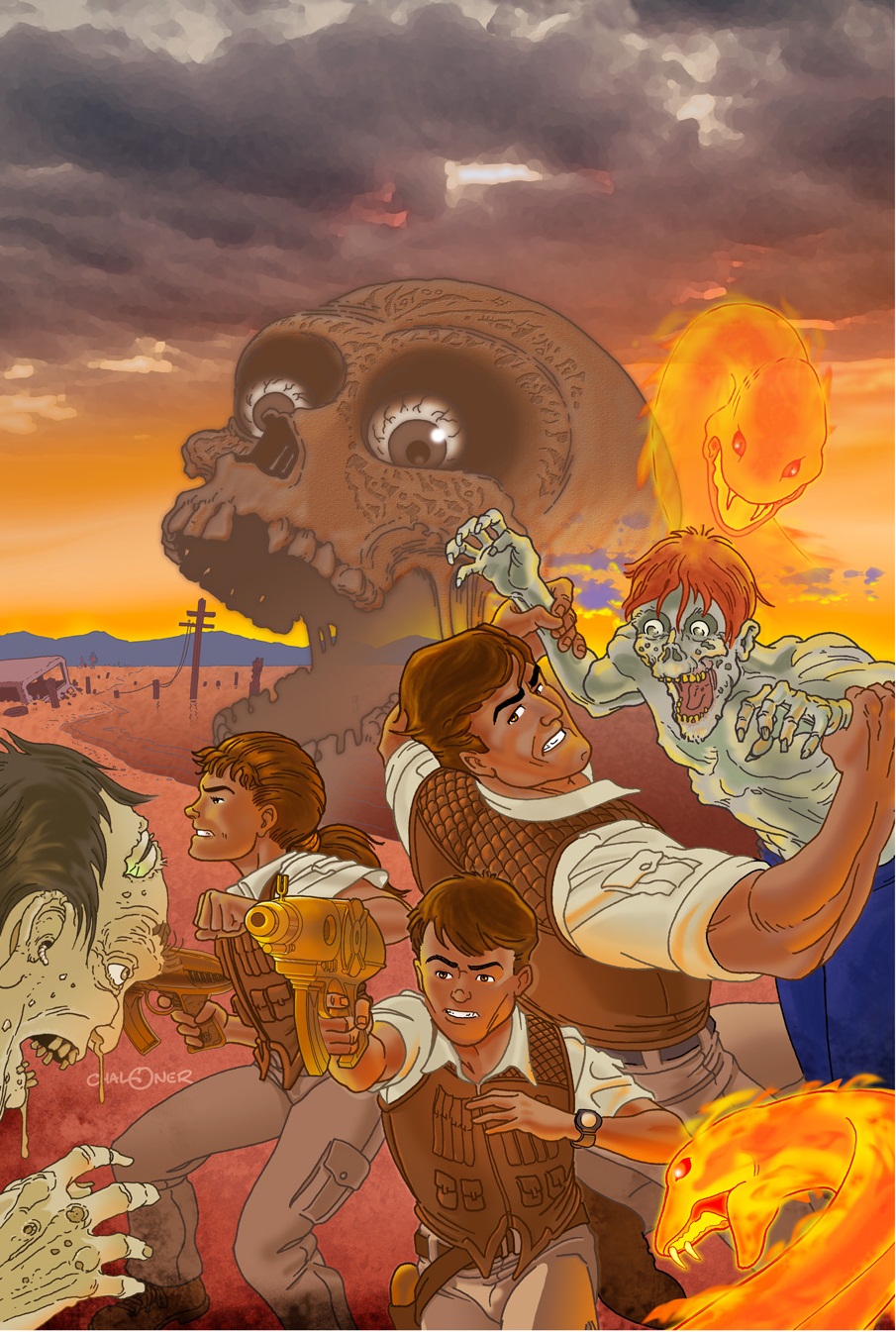
One of the final delays was that we wanted to include an excerpt and the cover from the second book, Doc Wilde and The Mad Skull, in the back of Frogs, so Gary Chaloner actually had to paint the thing. Seems like that takes time. Who knew?
Anyway, though it will get some tweaking between now and its actual publication, it is effectively done, ready for your eyes…
UPDATE: Getting this book out took longer than expected, and we opted to go with another cover design. You can see it here.
“If you’re seriously contending that you get a free pass to be an asshole by calling what you write ‘humor,’ or that humorists are under no obligation to have any manners, think again.”
This is a comment from a discussion going on on someone else’s Facebook wall. I’d reply there, but the woman whose wall it is isn’t someone I know and she has already spazzed out about people disagreeing with her public post, which was an attack on the Onion for its story “Heartbroken Chris Brown Always Thought Rihanna Was Woman He’d Beat To Death.” Her stance — and that of the guy I quoted above — is that satire shouldn’t offend.
Fuck that. If you’re not offending somebody, you’re not doing satire correctly, you’re just being amusing. And you’re not making a point, you’re just making a joke. The last thing a satirist, or a comedian of any stripe, or any goddamned artist of any sort, should be worrying about is whether they’re offending someone with their material, unless being inoffensive is, indeed, one of their goals as a creator. Sure, there are boundaries that you probably shouldn’t cross if you want to be a decent person (publicly attacking a child, for instance), but for the most part, nothing is sacred.
As novelist Tad Williams, who was also involved in this discussion, wrote, “There is no edge. The edge is a movable feast. A good humorist has to go with the gut, and sometimes the audience is in a slightly different place than expected. You can’t have ‘safe’ satire, because that’s not satire, that’s officially sanctioned merriment.”
So yeah, to put it in terms the guy I quoted used, you get a free pass to be an asshole and you’re not under any obligation to have any manners. That may cost you a fan or a friend sometimes, it may cost you a job, it may make you unpopular if you really touch a nerve. That’s why satire, why art, is brave. That’s one of the things that makes it matter. That’s one of the things that makes it real. That’s one of the things that makes it truth.
For those following the evolution of publishing and assorted matters, blogger JW Manus has an excellent post, What Does A Self-Publishing Service REALLY Do?, riffing off the previous post by author David Gaughran, “The Author Exploitation Business,” which I shared last week:
In Traditional Publishing, the Chain of Happiness works like this:
WRITER has to make the EDITOR happy
EDITOR has to make higher-up editors, the marketing department and the accountants happy
Higher-up editors have to make MARKETING happy
The marketing department has to make REVIEWERS and the NEW YORK TIMES book editor happy
The sales department has to make BOOK STORES happy
Everybody has to make the PUBLISHER happy
The PUBLISHER has to make the STOCKHOLDERS and BOARD OF DIRECTORS happy
Contrast that with the indie’s Chain of Happiness:
WRITER has to make the READERS happy
Notice what’s missing in the first chain of happiness? If you said “readers,” give yourself a gold star. If that list gives you some hints about why traditional publishing is in such disarray and why some self-publishers are succeeding beyond almost everybody’s expectations, give yourself another star.
And yes, I know there are many traditionally published books that make readers very happy. The point I’m making is about focus and priorities. With most publishers, and especially the Big Publishing Houses, reader happiness is a side effect, not a priority.
A compelling idea, and an accurate one.
The rest of her piece is likewise very compelling,and not just about self-publishing services. Read it here.
Yesterday was Free Comic Book Day. It got me thinking about my relationship to comics.
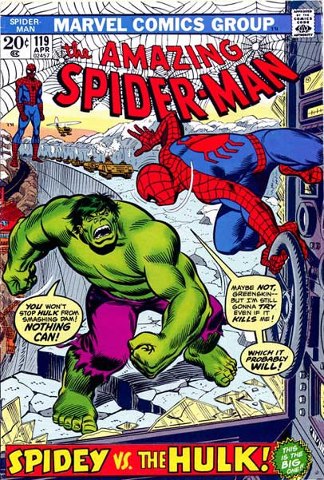
The comic above, The Amazing Spider-Man # 119, is the first comic I remember buying. I know I had others before it, but perhaps I didn’t actually choose them myself, but had them given to me. Whatever the case, I remember going into the 7-11 and choosing this comic and reading it. The result was an obsession that lasted for years, and a strong love of the medium that I still retain today.
That said, I can’t recall the last single issue of a comic I bought. I still read bound collections here and there, like the recent “Court of Owls” storyline in the Batman comics. There are some things I buy for my library as soon as they appear, like the incredible cloth-bound library editions of Mike Mignola’s Hellboy, or the “Absolute” edition of Warren Ellis’s Planetary. But mostly, I just don’t bother with comics these days.
I still love them. But they’re like old friends who’ve drifted away. I keep up with them via gossip. “Oh, Superman is seeing Wonder Woman? Good for him.” “Oh no, Damian Wayne died? That’s terrible, Bruce must be in agony.” “Peter Parker’s dead? Oh my god, that’s…actually really fucking humdrum at this point, unfortunately. Tell me when he’s back.”
It’s not that I’m not interested in reading them, because I am. But the reasons not to are so compelling. They’re too damned expensive, for one thing; for ten bucks, I can get two or three comic books I’ll read in under fifteen minutes. But that same ten bucks will get me two hours of entertainment at the cinema, buy me a book or ten that will give me many hours of enjoyment, get me ten songs I’ll be able to listen to forever, or even pay for a month of Netflix. Comics just don’t offer much bang for the buck when they cost so much.
It’s also a chore to keep up with them. The big companies love crossovers, and to be honest, so do I. But I’m too busy and distracted to have to follow all related series, and read the issues every month in proper order, in order to keep up with a storyline. The latest Batman mega-arc may be incredible, but if I have to hop spastically from title to title, and research the fucking reading order online, to keep up, it’s too much work for too little joy. You can’t just buy a single title, in individual issues or trade collections, and get a coherent storyline.
So, these days, though I miss them, I’m fine following the lives of my favorite comic book characters through hearsay. And, of course, through other media. I’m re-watching The Spectacular Spider-Man cartoon at present, and it’s exceptional. Of course, it lasted just two seasons, and now we have Ultimate Spider-Man, which isn’t. DC’s animated efforts tend to be incredible; we watched the animated adaptation of Frank Miller’s The Dark Knight Returns a few weeks ago, and it was great. And, of course, there are the movies. That’s where most people get their comics fix these days, and there, for the most part, the companies are getting it right.
Speaking of which, today we’re going to see the new Iron Man flick. Can. Not. Wait.
I’ve mentioned Penguin’s self-publishing scam before. In this blog post, novelist David Gaughran takes the publisher to task in much more detail. I’d say this is essential and important reading for any writer working in, or wanting to break into, the business these days.
And it’s not just Penguin, either. Many of the beloved traditional publishers, those stalwart protectors of lit’rature, nurturers of authors, are engaging in these practices. Go. Read. Remember.
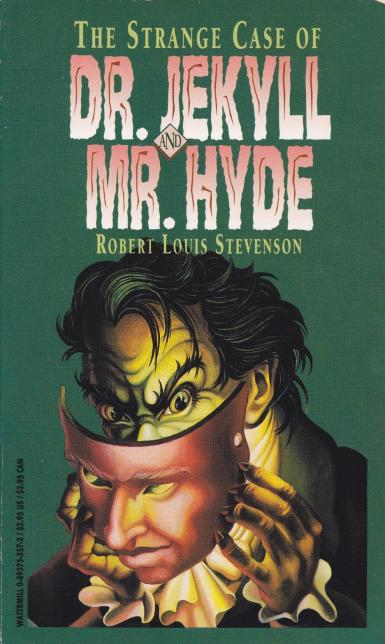
We all have our sunny side, our pat-the-kids-on-the-head-with-an-eternal-smile-of-warmth side, our non-controversial I-breathe-oxygen, how-’bout you? side. That’s our Jekyll, our potential human paragon, our angel.
But we all have our Hyde, too, our goddamnit-won’t-those-kids-shut-the-hell-up side, our you’re-a-fuckwit-because-you-don’t-agree-with-me side, our good-lord-I-want-to-fuck-that-stranger-straight-through-till-sunrise-in-all-the-least-photogenic-ways side.
We’re all the whole Magilla Gorilla, a churning stew of human potential and passion and instinct and mind and soul (whatever the hell that is). And that’s not a bad thing, nor are all the qualities we might shove into the Hyde box actually evilwickedbad in and of themselves. Trying to completely squelch Hyde makes you, at best, neurotic, at worst a slavering hypocrite enslaved by the desires you dare not show. How many anti-gay crusaders have gotten caught with somebody’s dick in their mouth at this point? Probably a small fraction of those who will be.
Still, we all like other folks to think well of us, so we at least refrain from mentioning a lot of the things Hyde says in our heads, and hopefully retain rational control over our impulses and emotions and actions.
Online, we get to fine-tune our public persona a bit. We have the time and distance to choose what we want to present, and how (though it’s all too easy to just hit SEND in an emotional moment and let your Hyde out for all to see; writer Hugh Howey had this happen to him recently and brought down a virtual enraged church picnic of self righteous wrath ‘pon his head). Some splash their personalities all over the internet like monkeys with paintbrushes, or even chimpanzees with machine guns. Some are naturally more guarded than others, and some have concerns beyond the simply personal when it comes to what they’re presenting.
Like writers.
I’ve pondered my own online Jekyll/Hyde mix for a few years now. Continue reading →
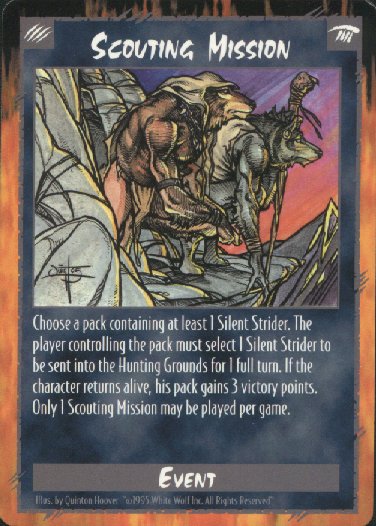
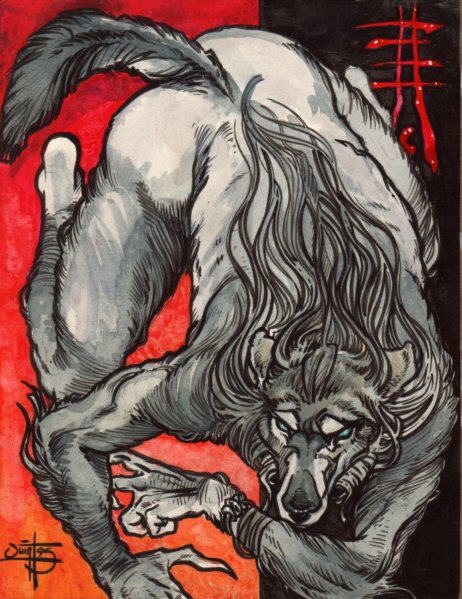
I didn’t know Quinton very well, but he did quite a few cards for us back when I was working on White Wolf’s Rage (best CCG evar):
We got to know each other a bit more on Facebook, and I was actually hoping to possibly recruit him to work on an Outlaw Moon book with me at some point. I’m sad that’ll never happen.
Here’s a posted eulogy from Quinton’s son, Justin:
Today we lost an incredible man. Most only knew him as an artist. A small few knew him as a friend; however only a select few got to know him as a father and husband. My father was an incredible person, even in time of strife. With all of the pride and stubbornness, he fought. He fought for alot of things. Mainly his families lively hood. It brings me great sadness to have lost a man I spent a life time trying to emulate. The last few years had become strenuous, but the little things kept him going. The picture with this eulogy shows that very reasoning. A simple day spent with his friend taking pictures and being outside doing what he loved. Much like the rest of his family, I feel he was taken from us far to early. There was so much he wanted to do, to name a few he wanted to come to my wedding and meet my family for the first time. Unfortunately this was taken away. Out of all this pain and anguish, I know he is finally at peace. My Dad had a lot of hard times, and was in considerable amounts of pain. No more will he have to suffer the things that hurt him the most. Whereever he may be now, I know he will still be fighting for the well being of his family. Truly one of the most selfless people I proudly got to spend 27 years knowing and speaking with. Dad, no matter where you went to, know that myself, my family, and your family have and will always love you. I thank you from the bottom of my heart and soul for everything you gave and tought to me. From shooting my first gun, to the last piece of lead I lay on paper.
He knew I wouldn’t leave him.
He’ll never leave me.
Quinton Hoover was a good man
I Love You
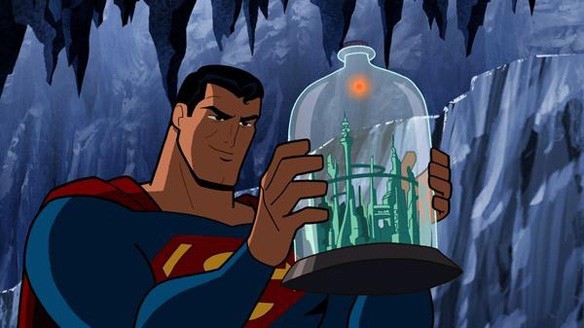
Today, in honor of Superman’s 75th anniversary, I’d like to share a story…
Not many people are aware of the fact that the Bottled City of Kandor actually uses kryponite-run nuclear reactors for power, and there is a (relatively) huge mass of the element beneath the city. Naturally, mining the ore can be very dangerous for those of Kryptonian descent, and early on even the best protective measures proved insufficient, as miners continued to develop terrible rashes even when wearing highly shielded suits. Superman ultimately solved the problem, of course, by developing a special cream which completely eradicated the rash and even had a mild pleasant scent. This salve is now sold in pharmacies in Kandor under the name “Kal-El Mine Lotion.”
I’ve been keeping quiet, mostly, since my return from Brazil, and since announcing the “imminent” release of Doc Wilde and The Frogs of Doom at the end of January. This is because I’ve been very busy working, but also because even I’m weary of my pattern of optimistic-announcements-followed-by-some-more-interminable-waiting. That said…
The release of Doc Wilde and The Frogs of Doom is imminent.
I just finished a complete overhaul of the Doc Wilde website, and you can read the details in this blog post there. I’ll be shifting a good share of Doc Wilde-related posts to the official blog in the future, as well as availing myself of the newsletter, which you can sign up for to make sure you get the latest news. Don’t fret, I’m not going to spam you with lots of emails; anyone who follows this blog knows how sporadic I can be. For the moment, the newsletter will be used just for practical updates on the books, but over time I plan to do some fun things with it (though still on a non-spammy basis).
While we’re talking about subscriptions, I may as well point out that you can also subscribe to this blog via the button in the sidebar. This is my personal space, and I’ll continue to talk not only about my writing and publishing adventures, but all the weird and wise and sometimes inappropriate things that occur to me.
Back on the subject of the Doc Wilde site, I’m very pleased with it. Swing by and take a look, check out the gallery of Gary Chaloner’s awesome artwork, read the reviews Frogs of Doom received when it was first published by Putnam, sign the guestbook. Go Wilde…
Interested in long term romantic relationships? Marriage? Sexual satisfaction? Sexual adventure?
Give a listen to this TED Talk by Psychotherapist Esther Perel, the author of Mating in Captivity: Reconciling the Erotic and the Domestic. I think she’s on the right track.
Everyone is all abuzz about the asteroid flyby and the meteorite strike in Russia this week, and it was quite spectacular, and scary. Some of the video footage from Russia is amazing; watching the fireball appear in the sky through someone’s windshield, burning closer and closer, I couldn’t help but think what a pants-shitting moment that had to be.
It also made me remember my own close encounter with a meteor, many years ago. I survived, just as I survived the time I was struck by lightning, though the meteor was both a lot less dramatic and a lot cooler.
I was a teenager, visiting my maternal grandparents in a backward crack in the world called Valle Mines, Missouri. They lived in a farmhouse off a rural highway with a fair chunk of land, much of it thickly forested. The forest, of course, was the good part, especially to a kid who’d retreated to the woods most of his life as an escape from a horrible life at home. The bad part was the isolation from culture, and the lack of things to do. Nowadays, they probably have a big Teabagger dance or something to pass the time.
Anyway, late one dark country night, I was out back, and for some reason I was standing on my grandparents’ picnic table. The only light was from the windows of the house, and the sky was clear. Suddenly, I saw a thin streak of fire lancing toward me. It passed about ten feet over my head, sputtering into sparks as it fully disintegrated about twenty feet away, just short of the woods. A shard of space rock crumbling to fairy dust before my eyes.
Another cosmic encounter also comes to mind. Back in 1997, Comet Hale-Bopp streaked slowly cross earth’s skies, incredibly bright and visible to the naked eye for a record 18 months. Living in town, it was tough to see because of the light pollution, but I had a wonderful visit with it one cold spring night.
We took my son, Nathaniel, who was just under a year old, on his first camping trip, to Lake Conasauga, the highest lake in Georgia, on Grassy Mountain in the Chattahoochee Forest. It was chilly, but he enjoyed the woods and the lakeshore. Our late great akita, Travis, played with us, and charged through the woods like a white rocket. Towards dusk, we retreated to our tent and snuggled in, and Nathaniel was happy. Happy until night fell, that is, and with it, the temperature.
It was like a switch was thrown. The sun disappeared and suddenly it was below freezing. And Nathaniel started crying. We bundled him in several layers of clothing, including a pair of my thick wool socks and my Polartec jacket, and nestled together deep into the sleeping bags. The crying stopped, and he was content.
He fell asleep, as did his mom. I lay there, listening to the night sounds. We had planned to hike to the top of the mountain at night to see the comet, but it was so comfortable in the sleeping bags, and so damned cold outside them. But, knowing this was my best chance, I mustered the strength. I woke my son’s mom to give her the chance to do likewise, but that wasn’t happening. She, and Nathaniel, were too content where they were.
So I pulled on my cold boots and crawled out of the tent. I let Travis off his leash and the two of us headed up the trail.
When we reached the summit, the world was spectacular. Dark ridges of forest stretched away in every direction, and the sky above was utterly cloudless and perfectly black but for its trillions of bright stars, so many stars, up high, without city lights, without smog. Just that sky, alone, would have been reason enough to clamber up that trail that night.
Hale-Bopp burned out there, a streak of star fire, huge and otherworldly, stark against that dark sky, a titan among the glittering pinpricks that were the stars. I stood there staring at it, the cold forgotten, my dog pacing and hunting night critters, for a long cosmic moment.
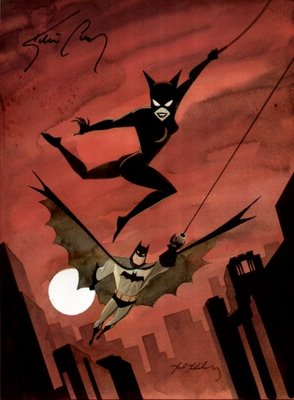
A lovely animated short from the creators of the classic Batman animated series, silent movie style, all elegant art and sleek action, with a great musical score.
So corporate bully boys Games Workshop are now insisting they own a trademark on the term “space marine,” which first appeared back in 1932 in the story “Captain Brink of the Space Marines” by Bob Olsen. They had a book by writer M.C.A Hogarth kicked off of Amazon for her use of this common, stock, standard, downright cliché science fiction trope.
Today I got an email from Amazon telling me they have stopped selling Spots the Space Marine because Games Workshop has accused me of infringement on their trademark of the word ‘space marine’.
If you go to the Trademarks Database and look up the word “space marine” you’ll find the Games Workshop owns a trademark on the term “space marine,” but it only covers the follow goods and services: IC 028. US 022. G & S: board games, parlor games, war games, hobby games, toy models and miniatures of buildings, scenery, figures, automobiles, vehicles, planes, trains and card games and paint, sold therewith.
Fiction isn’t included in that list, which means Games Workshop has no grounds on which to accuse me of trademark infringement.
I didn’t get my use of that term from Games Workshop. I got it from Robert Heinlein. Apparently the first use of the term was in 1932. E.E. Smith used it, among others. Also there are other novels on Amazon being sold that have “space marine” in the title. I don’t know why Games Workshop decided to complain about Spots in particular, but my guess is because the Kickstarter made it a little higher-profile than the average indie offering.
This is as bad as Marvel and DC Comics conspiring to share a trademark on the term “superhero,” barring all others from using it. It’s pointless and ridiculous and downright unfriendly to the creative community at large.
As for Games Workshop? Fuck those guys.
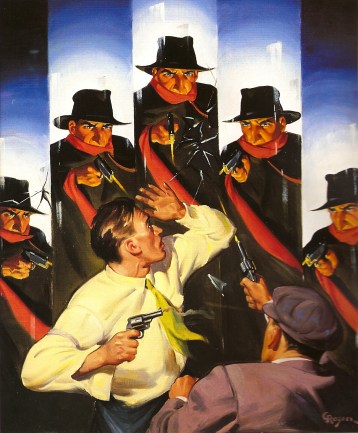
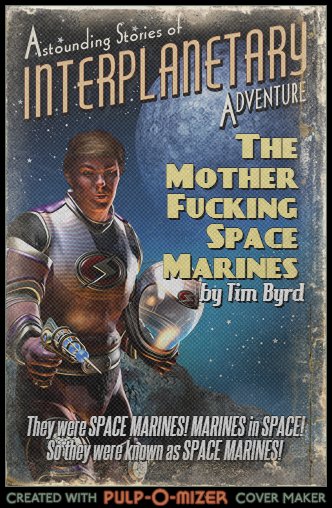
(Note: Like that cool pulpy cover I posted up there? You can make your own with the Pulp-O-Mizer at Bradley Schenck’s Thrilling Tales of the Downright Unusual website, which is a very cool place to visit…)
A friend and writer who I like and respect posted a status on Facebook this morning which referenced the indisputable fact that “there are a lot of dreadful books being produced” by self-publishers. I commented, “There are a lot of dreadful books being published by major publishers, and they sell them for a hell of a lot more money.”
He replied, starting by saying, “I actually expected this comment from you so much that I was going to write it for you right beneath my post.”
Which made me think. Am I that predictable? Am I that partisan, in the “battle” between traditional publishers (and traditionally published writers) and self published writers?
I’ve written quite a bit here and elsewhere about my experiences being traditionally published, and my decision to go indie. I’ve posted at length about the flaws in the traditional model and the strengths of the new one. I am absolutely pro-self publishing. But am I anti-traditional publishing?
No. I would say, rather, that I am pro-writer. And a writer’s first responsibility should be to himself and his work. He should choose the path, or paths, that best serve that responsibility, and whatever path he chooses, godspeed.
In the current ecosystem, I do think self publishing is a much more beneficial path for authors to take. Though it is a lot of hard work and there are no guarantees, if you build your audience (which all authors have to do), the potential gains are much greater than those to be enjoyed via traditional venues. Unless you are one of those very rare writers who gets big advances and actual promotion and support from a traditional publisher, you aren’t even a respected cog in the great machine. Your opinions are of little value, you have little say in the presentation or promotion of your own books (not that they will be promoted), the pay is terrible, and they will drop you in a hummingbird’s heartbeat if you miss sales goals by even a hair. And they won’t even miss you.
But it doesn’t have to be this way. Publishers can (and should) change their SOP, finding ways to actually nurture the talent on whose backs these companies ride. As I’ve pointed out before, everybody who works on your book gets a good salary and full benefits except you. The writer is Cinderella, scraping the floor clean for her step-sisters in publishing to walk on. But, again, it doesn’t have to be this way.
That may sound anti-traditional, but it’s actually loving critique. I love the book business. My experience with Putnam wasn’t a nightmare, it just wasn’t very satisfying or lucrative. I want the book business, at all levels, to thrive. I just want publishers to start treating writers the way they ought to be treated. Writers are the dream makers, they should at least get a bigger cut of the dream.
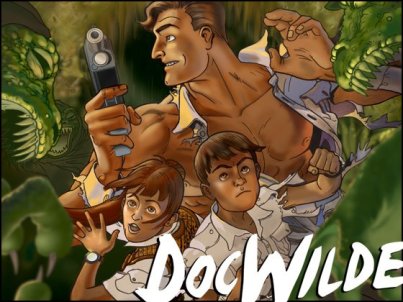
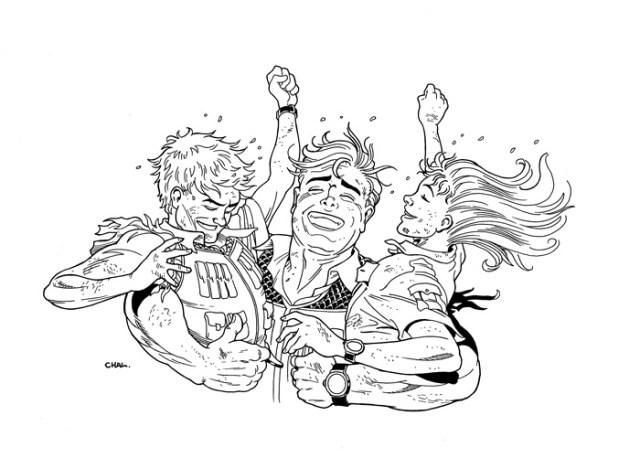
Months later than originally announced, artist Gary Chaloner and I are almost ready to release the new improved edition of Doc Wilde and The Frogs of Doom under the banner of Outlaw Moon Books. The book layout and design are done, most of the art is ready, and the remaining art is done and inked with just a bit of toning to finish it up. And it all looks beautiful. Gary has really knocked it out of the park, and I can’t wait to see what he does on the next book. (I’ve shared some of the art, in various stages of completion, in this album on Facebook, but there’s still a lot that no one has seen yet).
For those new to our saga, this novel is the first in an all-ages series of high adventure novels which I initially published with Penguin/Putnam. They contracted me for the first three, with more to follow, and published Frogs of Doom back in 2009. For various reasons I’ve covered at length on this blog, I then opted to negotiate my way out of my contracts, pulling Frogs from print and regaining full rights to all the books, in order to take advantage of the new self-publishing ecosystem to release the books in a nicer format, fully illustrated by Gary, with full creative control.
This new edition of Doc Wilde and The Frogs of Doom is not only gorgeously illustrated by an incredible artist, it contains my “Author’s Cut,” preferred (and expanded) version of the text. It is in every way superior to the first edition, and I’m excited to be able to share the book in the form I originally intended.
I have been helped along the way by a sizable group of angels who supported my Kickstarter nearly a year ago, providing funds to aid us in producing books of a quality not just matching the job Putnam did with the Wildes, but radically improving on it. They have cheerfully and stalwartly remained positive through months of delay and setback, and I’m humbled and grateful and thrilled to finally be able to give them something back.
So, when is the book due? ETA: any time now. And this time, it’s for reals.


 Under An Outlaw Moon