Caveat Author: The Author Exploitation Business

Greedy Penguin

I’ve mentioned Penguin’s self-publishing scam before. In this blog post, novelist David Gaughran takes the publisher to task in much more detail. I’d say this is essential and important reading for any writer working in, or wanting to break into, the business these days.

And it’s not just Penguin, either. Many of the beloved traditional publishers, those stalwart protectors of lit’rature, nurturers of authors, are engaging in these practices. Go. Read. Remember.

And spread the word.

The Author Exploitation Business

Shadowy News For Pulp Movie Fans…

The Shadow

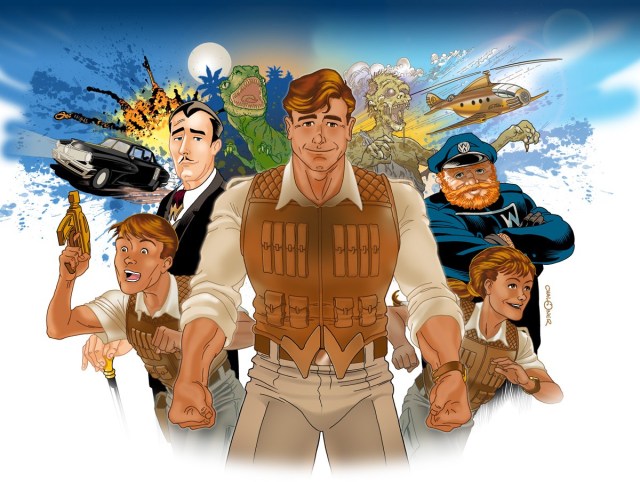
Some news on the Doc Wilde blog for fans of pulp action movies in general and 1994’s film version of The Shadow in particular:

Shadowy News

Which reminds me of one of my better Twitter statuses last year:

Lovecraftian Whimsy

Cthulhu

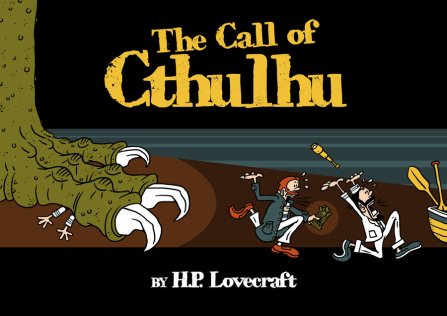
A short blog post on the  Doc Wilde site regarding Muzski’s awesome Lovecraft art…

Lovecraftian Whimsy

Superman’s Rash Solution

The Bottled City of Kandor

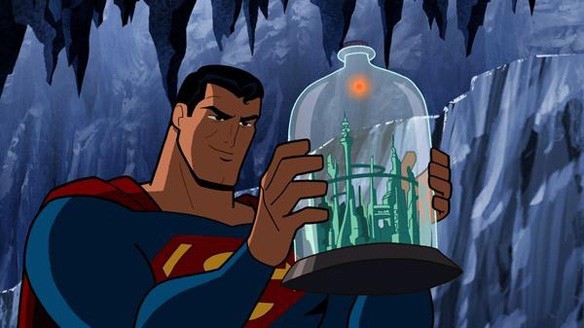
Today, in honor of Superman’s 75th anniversary, I’d like to share a story…

Not many people are aware of the fact that the Bottled City of Kandor actually uses kryponite-run nuclear reactors for power, and there is a (relatively) huge mass of the element beneath the city. Naturally, mining the ore can be very dangerous for those of Kryptonian descent, and early on even the best protective measures proved insufficient, as miners continued to develop terrible rashes even when wearing highly shielded suits. Superman ultimately solved the problem, of course, by developing a special cream which completely eradicated the rash and even had a mild pleasant scent. This salve is now sold in pharmacies in Kandor under the name “Kal-El Mine Lotion.”

Thank you! Thank you! I’ll be here all week…

Doc Wilde: The Final Update Before Publication!

A World of Adventure

I’ve been keeping quiet, mostly, since my return from Brazil, and since announcing the “imminent” release of Doc Wilde and The Frogs of Doom at the end of January. This is because I’ve been very busy working, but also because even I’m weary of my pattern of optimistic-announcements-followed-by-some-more-interminable-waiting. That said…

The release of Doc Wilde and The Frogs of Doom is imminent.

I just finished a complete overhaul of the Doc Wilde website, and you can read the details in this blog post there. I’ll be shifting a good share of Doc Wilde-related posts to the official blog in the future, as well as availing myself of the newsletter, which you can sign up for to make sure you get the latest news. Don’t fret, I’m not going to spam you with lots of emails; anyone who follows this blog knows how sporadic I can be. For the moment, the newsletter will be used just for practical updates on the books, but over time I plan to do some fun things with it (though still on a non-spammy basis).

While we’re talking about subscriptions, I may as well point out that you can also subscribe to this blog via the button in the sidebar. This is my personal space, and I’ll continue to talk not only about my writing and publishing adventures, but all the weird and wise and sometimes inappropriate things that occur to me.

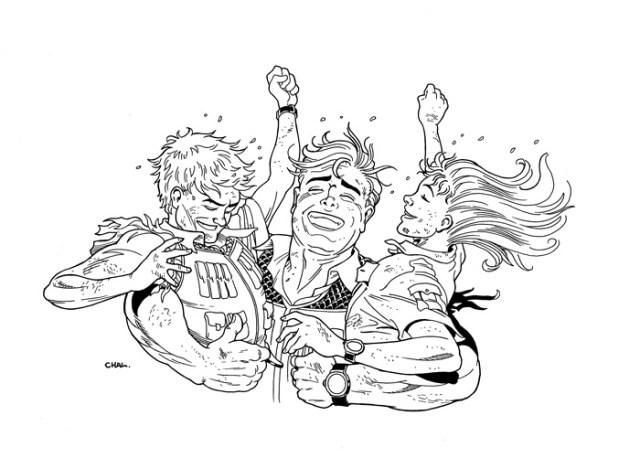
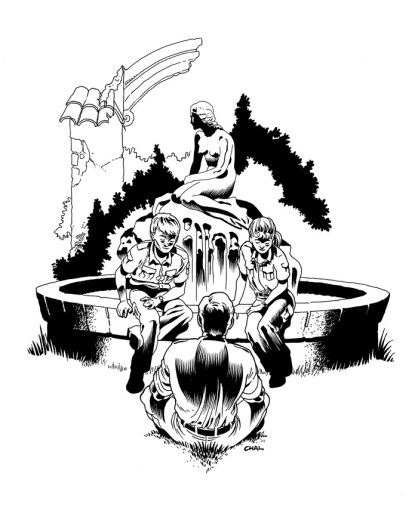
Back on the subject of the Doc Wilde site, I’m very pleased with it. Swing by and take a look, check out the gallery of Gary Chaloner’s awesome artwork, read the reviews Frogs of Doom received when it was first published by Putnam, sign the guestbook. Go Wilde…

DOC WILDE ADVENTURE HEADQUARTERS

The Mother Fucking Space Marines

SPACE MARINES

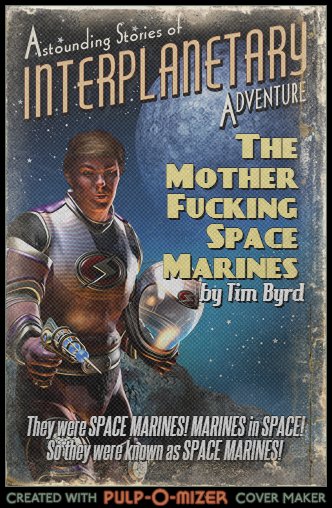
So corporate bully boys Games Workshop are now insisting they own a trademark on the term “space marine,” which first appeared back in 1932 in the story “Captain Brink of the Space Marines” by Bob Olsen. They had a book by writer M.C.A Hogarth kicked off of Amazon for her use of this common, stock, standard, downright cliché science fiction trope.

From her blog:

Today I got an email from Amazon telling me they have stopped selling Spots the Space Marine because Games Workshop has accused me of infringement on their trademark of the word ‘space marine’.

If you go to the Trademarks Database and look up the word “space marine” you’ll find the Games Workshop owns a trademark on the term “space marine,” but it only covers the follow goods and services: IC 028. US 022. G & S: board games, parlor games, war games, hobby games, toy models and miniatures of buildings, scenery, figures, automobiles, vehicles, planes, trains and card games and paint, sold therewith.

Fiction isn’t included in that list, which means Games Workshop has no grounds on which to accuse me of trademark infringement.

I didn’t get my use of that term from Games Workshop. I got it from Robert Heinlein. Apparently the first use of the term was in 1932. E.E. Smith used it, among others. Also there are other novels on Amazon being sold that have “space marine” in the title. I don’t know why Games Workshop decided to complain about Spots in particular, but my guess is because the Kickstarter made it a little higher-profile than the average indie offering.

This is as bad as Marvel and DC Comics conspiring to share a trademark on the term “superhero,” barring all others from using it. It’s pointless and ridiculous and downright unfriendly to the creative community at large.

As for Games Workshop? Fuck those guys.

(Note: Like that cool pulpy cover I posted up there? You can make your own with the Pulp-O-Mizer at Bradley Schenck’s Thrilling Tales of the Downright Unusual website, which is a very cool place to visit…)

Tim Vs. Traditional Publishing

don quixote

Clarification time.

A friend and writer who I like and respect posted a status on Facebook this morning which referenced the indisputable fact that “there are a lot of dreadful books being produced” by self-publishers. I commented, “There are a lot of dreadful books being published by major publishers, and they sell them for a hell of a lot more money.”

He replied, starting by saying, “I actually expected this comment from you so much that I was going to write it for you right beneath my post.”

Which made me think. Am I that predictable? Am I that partisan, in the “battle” between traditional publishers (and traditionally published writers) and self published writers?

I’ve written quite a bit here and elsewhere about my experiences being traditionally published, and my decision to go indie. I’ve posted at length about the flaws in the traditional model and the strengths of the new one. I am absolutely pro-self publishing. But am I anti-traditional publishing?

No. I would say, rather, that I am pro-writer. And a writer’s first responsibility should be to himself and his work. He should choose the path, or paths, that best serve that responsibility, and whatever path he chooses, godspeed.

In the current ecosystem, I do think self publishing is a much more beneficial path for authors to take. Though it is a lot of hard work and there are no guarantees, if you build your audience (which all authors have to do), the potential gains  are much greater than those to be enjoyed via traditional venues. Unless you are one of those very rare writers who gets big advances and actual promotion and support from a traditional publisher, you aren’t even a respected cog in the great machine. Your opinions are of little value, you have little say in the presentation or promotion of your own books (not that they will be promoted), the pay is terrible, and they will drop you in a hummingbird’s heartbeat if you  miss sales goals by even a hair. And they won’t even miss you.

But it doesn’t have to be this way. Publishers can (and should) change their SOP, finding ways to actually nurture the talent on whose backs these companies ride. As I’ve pointed out before, everybody who works on your book gets a good salary and full benefits except you. The writer is Cinderella, scraping the floor clean for her step-sisters in publishing to walk on. But, again, it doesn’t have to be this way.

That may sound anti-traditional, but it’s actually loving critique. I love the book business. My experience with Putnam wasn’t a nightmare, it just wasn’t very satisfying or lucrative. I want the book business, at all levels, to thrive. I just want publishers to start treating writers the way they ought to be treated. Writers are the dream makers, they should at least get a bigger cut of the dream.
The Imminent Return of Doc Wilde

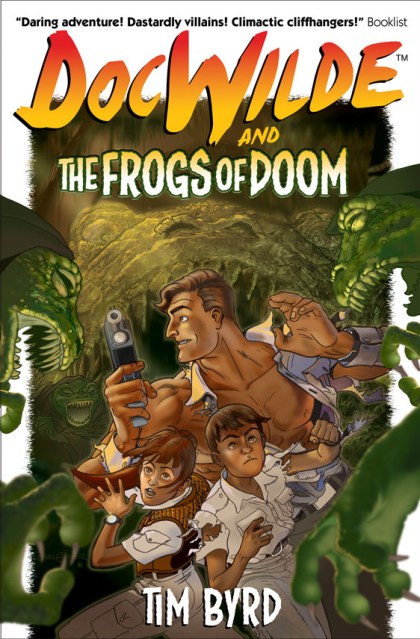
DOC WILDE AND THE FROGS OF DOOM

Whew. Finally.

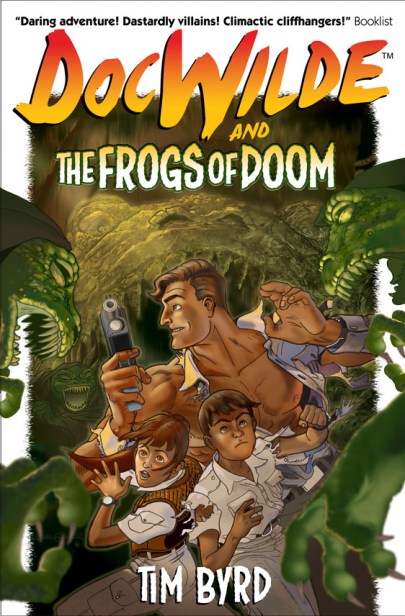
Months later than originally announced, artist Gary Chaloner and I are almost ready to release the new improved edition of Doc Wilde and The Frogs of Doom under the banner of Outlaw Moon Books. The book layout and design are done, most of the art is ready, and the remaining art is done and inked with just a bit of toning to finish it up. And it all looks beautiful. Gary has really knocked it out of the park, and I can’t wait to see what he does on the next book. (I’ve shared some of the art, in various stages of completion, in this album on Facebook, but there’s still a lot that no one has seen yet).

For those new to our saga, this novel is the first in an all-ages series of high adventure novels which I initially published with Penguin/Putnam. They contracted me for the first three, with more to follow, and published Frogs of Doom back in 2009. For various reasons I’ve covered at length on this blog, I then opted to negotiate my way out of my contracts, pulling Frogs from print and regaining full rights to all the books, in order to take advantage of the new self-publishing ecosystem to release the books in a nicer format, fully illustrated by Gary, with full creative control.

This new edition of Doc Wilde and The Frogs of Doom is not only gorgeously illustrated by an incredible artist, it contains my “Author’s Cut,” preferred (and expanded) version of the text. It is in every way superior to the first edition, and I’m excited to be able to share the book in the form I originally intended.

I have been helped along the way by a sizable group of angels who supported my Kickstarter nearly a year ago, providing funds to aid us in producing books of a quality not just matching the job Putnam did with the Wildes, but radically improving on it. They have cheerfully and stalwartly remained positive through months of delay and setback, and I’m humbled and grateful and thrilled to finally be able to give them something back.

So, when is the book due? ETA: any time now. And this time, it’s for reals.

HURRAY!

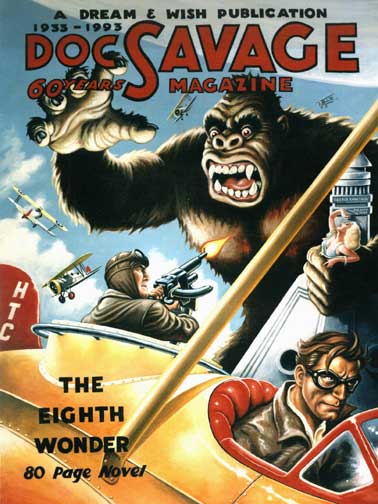
Doc Savage Vs. King Kong!

Doc Savage vs King Kong

I have returned from the jungled mountains of Brazil, renewed, a silly smile on my face, and ready to get back to work on the Doc Wilde adventures. I have a lot to write about, and will get to it as I can, but I wanted to share this cool news from friend of the Wildes and fellow pulpster Will Murray:

Eighty years ago in February, 1933 the Street & Smith company released the first issue of Doc Savage Magazine, introducing one of the most popular and influential pulp superheroes ever to hit the American scene. Doc Savage was the greatest adventure and scientist of his era, and while his magazine ended in 1949, he influenced the creators of Superman, Batman, Star Trek, The Man from UNCLE and the Marvel Universe—to name only a few.

While that first issue of Doc Savage was fresh on Depression newsstands,  Universal Studios released one of the most important fantasy films of all time. Everyone  knows the story of how King Kong was discovered on Skull Island and hauled back to New York in chains, only to perish tragically atop the world’s tallest  skyscraper, the Empire State Building.

As it happened, that was where Doc Savage had his world headquarters. For decades, fans have wondered: Where was Doc the day Kong fell? Continue reading

Doc Wilde Abroad…

Memories...

A quick update for Doc Wilde fans and our largely wonderful Kickstarter supporters (who have responded to our delays with almost universal grace and understanding)…

I had hoped to have Doc Wilde and The Frogs of Doom out by now, indeed by Christmas. Fortunately, I hesitated to promise it by then, because, clearly, that would have been a mistake. We are very, very close to completion, and Gary is finishing up the final artwork and layout, but the way things have timed out have presented a new obstacle, at least for the near future.

I am in Brazil right now, pretty much for the month. (A special thanks to Richter and Thomas, and of course to my son Nathaniel, for taking care of the Byrdcave and the dog while I’m away). The trip is both a fantastic vacation and a chance to work with our lovely translator, Nydia Macedo, on prep for the Brazilian editions of the books. I’m having a wonderful time, but my online access is very limited, so my back-and-forth with Gary is going more slowly, and once he’s finished with art and layout, I won’t really be able to check printing proofs until I’m back in the states next month.

When I’m back, things should go very quickly, and book 1 will be out in the world where it belongs.

Misadventures In Holiday Book Shopping (UPDATED)

bookstore

Being a fan of the local indie bookstore as an institution, I went out to do a bit of holiday shopping on Saturday. I had two books I wanted to buy. My chosen bookstore, a very good shop which has a big inventory and many author events (keys to the fact that it thrived even when the market consisted mainly of the big book chains), had one of the two (a perennial seller) in stock. The other I told them I’d like to special order.

The on-hand volume was twice the price I’d have spent online, but I had credit from previous dealings, so I bought it anyway.

The clerk looked up the other. “We can’t get that,” he said. He couldn’t explain why a book in print, published by Dell, should be beyond the powers of their distribution system. They’re not a new store, and I assume they do special orders all the time.

So, as a customer, I entered their shop with two specific books in mind, aware of the books’ availability and pricing online, but wanting to support the indie. One book cost me double the money I needed to spend. The other book was simply impossible to obtain.

That impossible book just landed on my doorstep, from Amazon. They not only had the book, they had it for cheap, shipping cost me nothing, and they got it to me inside of 48 hours. They got the sale because the local store either lacked a certain competence or wasn’t willing to find the means to get me the book I wanted.

Local shops can thrive, and this one does. If their owners are smart, and make themselves into community institutions that offer great customer service and special benefits and events, they can resist Amazon’s eminence in a way they were never able to resist the intrusion of huge chain stores like Borders and Barnes & Noble. But they need to actually be able to get the books desired by their customers to those customers, efficiently, or they’ll lose valuable business. And that’s never good.

I’ll go back to the shop because I’m fond of it. But someone else may have walked out thinking, “Well, from now on, I’ll just go online…”  They’d have lost not only this sale but all the others that customer might possibly have made.

UPDATE: When I wrote the above, I forgot to mention that two weeks earlier I had gone to this shop’s website and used their automated search system to request ordering information on a title. Nearly a month later, I have yet to hear anything at all back regarding that search.

Where, Oh Where, Is Doc Wilde?

Doc Wilde and The Frogs of Doom

Time for what will hopefully be the last update before we start getting Doc Wilde books into precious readers’ hands…

Artist extraordinaire Gary Chaloner is polishing up the last bits of art for the long-awaited rerelease of Doc Wilde and The Frogs of Doom, and it has been worth the wait. The cover above is nicely representative of his work, and if you glance to the image of the previous iteration in the sidebar on the right, you’ll notice he’s made it even better (though it still needs a bit of fine-tuning).

I’m doing a few final alterations to the text and end matter (the acknowledgements and author’s notes, that sort of thing), then that goes to Gary and he will polish the whole thing into a shiny, shiny book.

I hope to at least have ebooks into folks’ gadgets (and hopefully for sale) by Christmas. No guarantees, but I hope that. The proofing process for the paperback will likely take more time, as will Kickstarter special bits like posters. But we’re on the job, and as we finalize this book, we’re already getting a start on putting together a great edition of book 2, Doc Wilde and The Mad Skull.

This has been a major learning process for us, but that was to be expected. I’m disappointed we’ve had the delays and obstacles, but I’m more sanguine about it all now that we’re about to actually have the first book rereleased into the wild where it belongs. In the future, I’ll scale my expectations back somewhat when announcing release schedules, because “they” are right: it always takes longer and costs more.

But the final result is going to be something to be proud of.

I want to once again thank all of our friends who’ve supported us in this project. Your patience has been humbling. Your help has been crucial in allowing us to take the time to do things properly, in order to release the books to a high standard of quality. You’re all a part of the Wilde family and I hope you’ll join us on many more adventures for years to come.

The Wildes

The Spider Is Dead! Long Live The Spider!

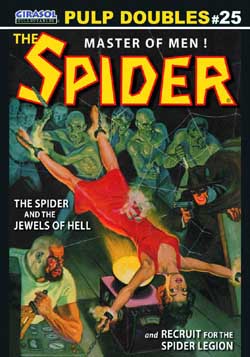
For the past few years, I’ve subscribed to Girasol Collectables’ “Spider Pulp Doubles” series reprinting the classic adventures of one of pulp’s greatest heroes, The Spider. Four times a  year, I’d receive a nicely produced magazine-sized trade paperback containing two of these apocalyptic wonders which were originally published back in the thirties, and I’ve enjoyed reading them and watching my shelves sag with my growing pulp collection.

The latest, pictured above, arrived today, but with it came a dire note: Continue reading

A Note From Doc Wilde’s Workshop

Wondering about what’s happening with Doc Wilde?

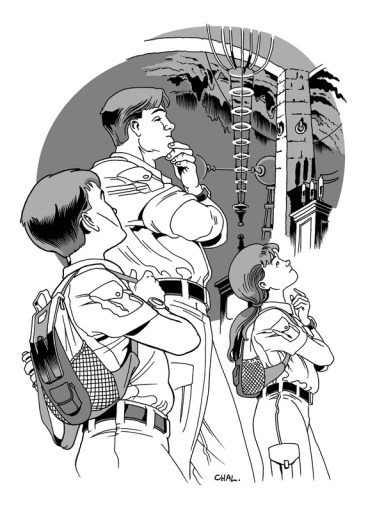
You’re in the right place. As you may know, I pulled the series from Putnam in order to use the tools of the new indie publishing revolution to produce the books the way I’d originally envisioned them, including covers and a lot of incredible interior art by comics maestro Gary Chaloner. The original plan had been to have three of Doc’s adventures out by the end of this year, but as I’ve explained previously, this plan has fallen to Murphy’s Law.

I’m not at all happy with that, but the situation is what it is. Gary and I are working steadily on getting the first book, the re-release of Doc Wilde and The Frogs of Doom, out in time for Christmas. I’d say even sooner, but such statements seem to like to come back and bite me on the ass.

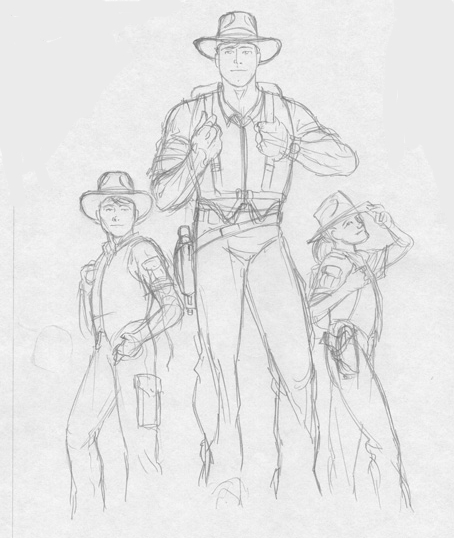
As you can see above (as well as in previous posts, and in my “Doc Wilde” photo album on Facebook, which is viewable by the public), the work Gary is doing is amazing, and well worth the wait.

In other exciting news, we’ve added a brilliant new member to Team Wilde, taking an important step toward global domination. My lovely friend Nydia Macedo has contracted to translate Doc Wilde and The Frogs of Doom into Portuguese for release in Brazil. The Brazilian edition will include the same Gary Chaloner design and art as the English edition, and will be just the start of worldwide availability of Doc Wilde’s astonishing adventures.

Welcome to the family, Nyd.

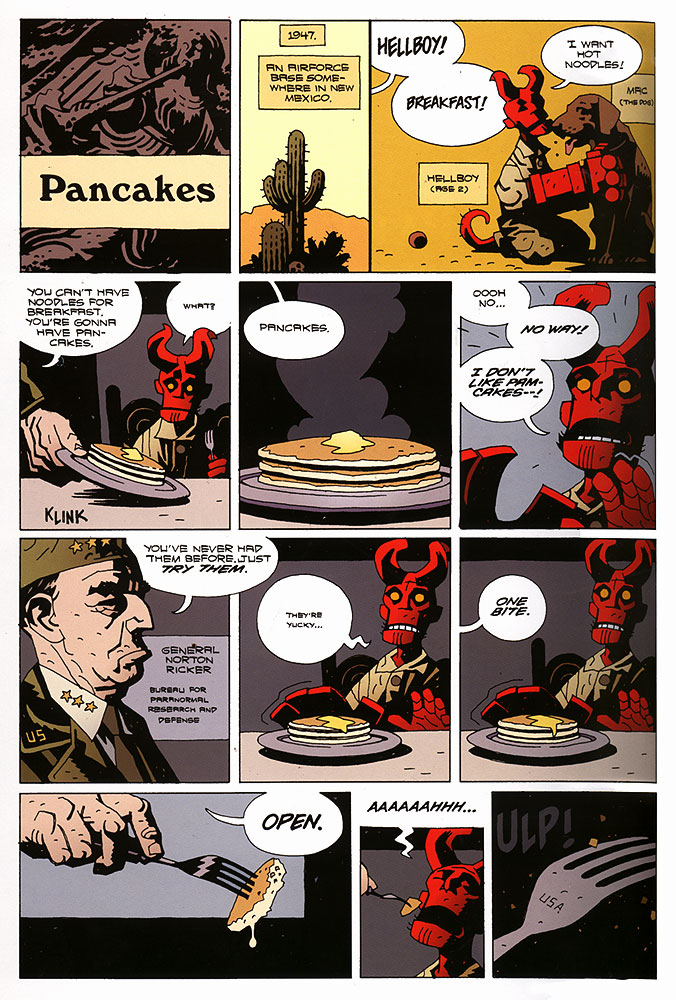
PANCAKES

In certain circles, there has been a royal stink the past few days about, of all things, pancakes. I don’t actually know the particulars and feel like my brain cells are better occupied with other things, but as an antidote to that particular venom, and any other you may be suffering from, I offer up this classic Hellboy tale by Mike Mignola. I hope it’s okay to do so, as these two pages are widely available on the net, and I originally read the tale as a free digital comic on the Dark Horse Comics website. If I hear otherwise, I’ll remove it.

Continue reading

Regarding Harper Voyager’s Submission Portal

Harper Voyager has put out a short-term call for unagented submissions:

Yes, it’s true! We are delighted to announce an exciting joint venture that will offer talented aspiring writers the chance to join our global science fiction and fantasy imprint.

The submission portal, http://www.harpervoyagersubmissions.com, will be open from the 1st to the 14th of October 2012. The manuscripts will then be read and those most suited to the global Harper Voyager list will be selected jointly by editors in the USA, UK and Australia.  Accepted submissions will benefit from the full publishing process: accepted manuscripts will be edited; and the finished titles will receive online marketing and sales support in World English markets.

Voyager will be seeking an array of adult and young adult speculative fiction for digital publication, but particularly novels written in the epic fantasy, science fiction, urban fantasy, horror, dystopia and supernatural genres.

See? The impact of ebooks and Amazon is having yet another positive effect on the publishing ecosystem for writers: a big publisher is actually open to unagented submissions (imagine that) if only for a limited time (two weeks, feh), with the successful submissions going on to be released digitally.

It’s an obvious attempt to adapt, which is to be respected (and hopefully emulated by other publishers), though I would look VERY closely at any contract they offer, particularly as regards the royalties paid (this is a royalty only deal, no advance), lifespan of the agreement (since it’s all-digital, it’d be all too easy for Harper to keep books “in print” forever and lock in a paltry royalty), and attendant rights (this is digital only, but do they restrict the authors from taking full advantage of print and other rights?). I’d also look for guarantees of some real level of promotion and marketing; if they’re just going to throw the books out there like they usually do, with little or no actual support, the author is gaining very little beyond short term gain (mainly editorially, and perhaps in cover design) for long term commitment that will no doubt pay most of its profits back to Harper.

I suspect new authors are better off doing it themselves, but for those who can only believe in their abilities if they’re officially allowed to join the club, it’s good that more opportunities are starting to appear. Thank Amazon: publishers know they have to stay viable, and that they have to start recruiting more raw talent (a lot of established writers will be leaving their houses over time to do things themselves) and taking full advantage of digital platforms. But if the authors are getting anything less than at least 50% of the profits, they’re not doing themselves much of a favor by going this route.

Kate Elliott’s Omniscient Breasts

I’m usually annoyed when someone pulls out the “male gaze” concept in a discussion of art and culture. While the idea has undeniable merit, it is often wielded as a bludgeon of ABSOLUTE TRUTH. In other words, men like looking at sexy women and it ruins the world, do not pass go, do not collect two hundred dollars.

I happen to think that much of this sort of thing has its roots in the innate differences in men’s and women’s cognitive wiring. That doesn’t mean we should just accept the baseline set by our neurology as the sole standard to consider, but it does mean that there’s probably nothing wrong with men liking to look at sexy women, or vice versa, or even having art that caters to such desire.

Still, just as we aspire to more than simple orgasm in our relationships, we should aspire to higher levels of cultural relationship as well. At the very least, we should think about these things, and consider how the ways that we think and create impact the way we relate to each other.

Author Kate Elliott has written a very balanced, thoughtful post considering the male gaze (and other gazes) in fiction, and I recommend it for everyone, but particularly for writers. She avoids the fanatic’s tendency to use the concept as a blanket condemnation of men and their wicked staring eyes, which I appreciate as a man with a finely tuned male gaze of my own, and shares some insights I’ve never considered. I’m a better person, and likely a better writer, for having read it.

You can read it here.

Fear of a Writing Planet: On John Green, Self-Publishing, and Amazon

A thoughtful post by novelist John Green is making the rounds today regarding self-publishing and Amazon:

I wanted to criticize Jeff Bezos, the CEO of Amazon, because I felt that in his introduction of the new kindles, Bezos repeatedly peddled the lie that a book is created by one person, and that therefore a book’s author should be the sole entity to profit from the sale of the book. (Aside, of course, from Amazon itself.)

Bezos and Amazon are consistent in their promotion of this lie, because it encourages the idea that the publishing landscape today is bloated and inefficient and that there is a better, cheaper way to do it—a way where all books can cost $1.99 with most of that $1.99 going to the author. Readers and writers both win then, right?

Well, no. Because the truth is, most good books are NOT created solely by one person: Editors and publishers play a tremendously important role not just in the distribution of books, but in the creation of them…Without copyeditors and proofreaders, my books would be riddled with factual and grammatical errors that would pull you out of the story and give you a less immersive reading experience. Publishers add value, and lots of it, and without them the overall quality and diversity of books will suffer.

Unfortunately, as fair-minded as Green obviously tries to be, at least toward self-publishing in general if not toward Amazon, he falls into the same trap a lot of defenders of traditional publishing fall into. He assumes that the current publishing infrastructure isn’t replicable within a self-publishing paradigm. This is flatly untrue. Continue reading

Are Self-Published Books Crap?

I really do wish this self-publishing ebook market would implode. It’s loaded to the gills with idiots, fools, and just by-Jove lousy writing. The purveyors of this monstrosity are, quite frankly, a bunch of jerks. I hope they all get ass-cancer and die horrible, painful deaths.

Thus spake writer James Robert Smith on his blog a while back. There are quite a few folks out there who share his view, and Smith often posts this sort of thoughtful musing about self published books and the presumably malignant souls who write them. Because what could be more malignant than putting out a book that inspires some good man to wish you get ass cancer and die an agonizing death?

To be fair, there is a great deal of utter crap being self-published, and unless you act as a rational consumer you can drown in it. But if you exercise roughly the same amount of care it takes in a bookstore to find something worth reading among the stacks of largely mediocre books, you can largely avoid buying shitty books.

Look at the cover; if it looks crappy, the author didn’t bother with doing better, and odds are the same holds for the writing. Read the reviews; yes, there are some slimy writers out there gaming the review system, but overall it’s still useful. Finally, before committing to buy, make sure you download the free reading sample offered by online vendors; if the writer can’t write, you’re gonna know that very quickly. Then, please, whatever your opinion of the book, review it on the site, even if you only write a few lines. A good review will help a writer who entertained you; a bad review will help warn others away.

It’s a time of great change in publishing, and self-publishing is the wild west. But it’s actually great for writers, and for readers, as I’ve written about on this blog (check the “Publishing” category in the sidebar), most notably here.

Here’s a thought experiment for you: Continue reading

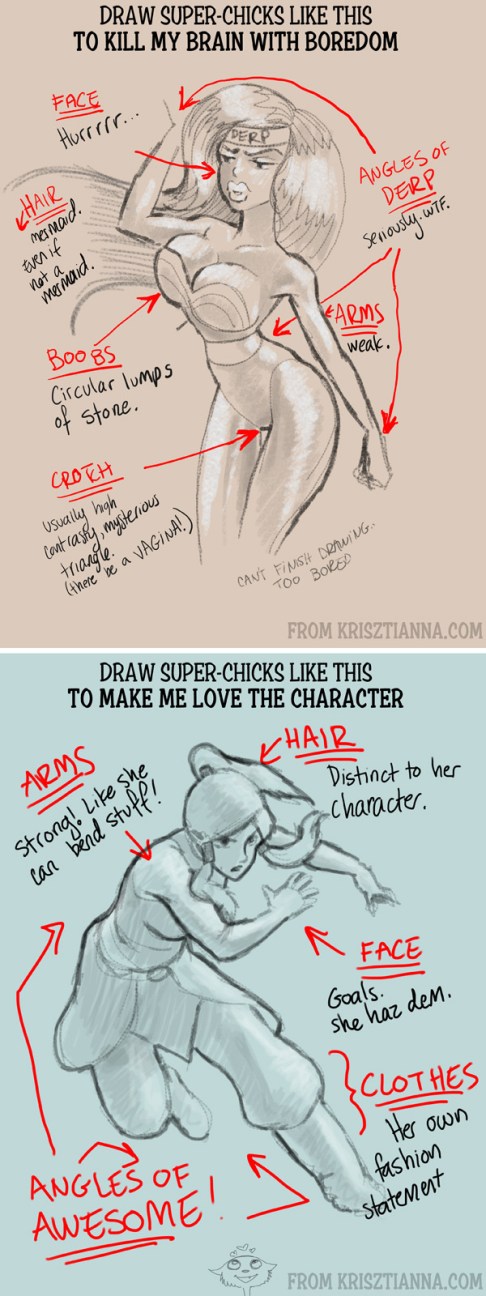
How To Draw Super-Chicks

An awesome commentary on how women are portrayed by artists from the damned talented Krisztianna: