The Passion of the Tim

"It's just the beast in me..." --Elvis Presley, JAILHOUSE ROCK

Hiatus over.

The past couple of days were rough ones. Kate and I were getting along wonderfully again, then POW, we stumbled over some truly picayune stuff and suddenly were back in the stress zone.

Neither of us acted as well as we might have, both of us being human, but I have to lay claim to the lion’s share of the blame. I overreacted to some things, then my mind wouldn’t let me release it even as I kept trying to. Kate was visiting her family, and wanting to go be with them, and we were arguing via text. I kept saying stuff like “It’s okay, go, I want you to enjoy the time with your family,” and I was sincere…but there was a rhetorical snapping turtle in my head that would only let me sit calmly a minute or two before throwing some new antagonistic comment out and insisting I send it her way. And I would try to maintain self control and not send it, but would lose the fight. Then after some more shared friction, I’d be back to saying I didn’t want to keep her from her family.

And, I wound up damn near destroying our relationship, which we’d managed to rebuild from our earlier problems. By the time I went on “hiatus,” I felt I’d lost all hope, and was so devastated I didn’t think I’d be able to do anything positive or productive for a long time…if ever again. Continue reading

Free, Easy Ways You Can Help Authors (Please Do These Things!)

Writing has always been a questionable way to make a living.

Yeah, occasionally one of us gets lucky and makes millions, but you may as well plan around winning the lottery. It’s not even a matter of talent…while the bestseller lists are often ruled by writers whose output is an insult to paper and ink, ungodly talents struggle to pay the rent and have to work other jobs to support their families.

But you, as a reader, have the power to help writers you like. Your most basic use of this power, of course, is simply spending money on their work, which is a sacred act. You can take that further by buying additional copies as gifts for others. You can even make a point of actually buying books new, rather than nabbing used copies or reading them at the library.

(Neither of which, I have to tell you, I really have much issue with. As a writer, I write to be read, so the more people reading my work, wherever they get it, the happier I am, on a certain overarching level. And it’s true that someone who reads one of your books for free or cheap may like it so much that they’ll buy your next one fresh off the shelf, where the sale does you the most good. All the same, it’s indisputable that succeeding as a writer is tough, and as a reader your decision to buy new is a powerful act and can make all the difference. I want most of all to be read…but the more sales I get, the better able I am to stay in print and publish even more stuff and make a living at all.)

So yeah, buying is very important. But it’s not all you can do to help struggling scribes, and there are easy things you can do that don’t even cost you anything.

Back in April, author G.P. Ching (who apparently kicks patootie at Guitar Hero) blogged about this very topic, and did such a good job, I don’t think I can improve on it. Her full post is here. In it she offers five ways readers can help writers “that cost absolutely nothing but go a long way toward helping to foster their potential.”

As a struggling mid-lister, I assure you that if you do these things not only will they help, they will be enormously appreciated.

Here are G.P.’s suggestions on free ways to help writers:

5.  Forward their press 
Whether it is a tweet, post, or status message, someone who follows you might be interested. Retweeting or sharing a post only takes a second but could mean connecting a potential reader with an author they’ll love.
4. Tell a friend
If you like someone’s work, there’s no better way than word of mouth to promote their cause. Even if you haven’t read the specific book yet, your comment can inform someone of the book’s availability.  And, of course, if you have read the book, let others know you liked it.  Indie authors don’t have large publicity budgets and rely on personal connections more than anything else for promotion.
3.  Tag and “like” their book on the bookseller’s site
At the bottom of a book’s page on Amazon, there are check boxes to tag a book.  When you check one, it strengthens the association between the book and that category. So, when someone else searches on the category, books with more tags appear higher in the search results.  This increases exposure for the work.
When you “like” a book on Amazon or Barnes and Noble, it adds a message on your Facebook newsfeed and is good promotion for the title.
2.  Add the author’s book to your To-Be-Read pile on Goodreads
All of your Goodreads followers get a glimpse of the cover and can see that you added it. Plus, it increases the number of people associated with the book which can garner interest in the title.
1.  Write a review
Often if your intention is to write a review, an author will provide you with a free copy of the book.  Whether on a blog or on a bookseller’s site, reviews help authors sell more books and are greatly appreciated.
All great suggestions.
More Thinking About Writing (Regarding Tools and Positioning)

Recently I’ve blogged about my attempts to optimize my approach to writing day to day, to hopefully become more productive and prolific. A huge part of that, by necessity, is that I have to deal with my depression; if I can’t, I might as well throw in the towel.

This week, I start a course of ECT (electroconvulsive therapy), which will hopefully give me the edge in that fight. I’m assuming it will, so I’m working on setting the stage for the writing I plan once it’s over.

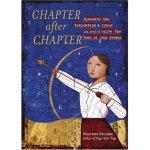
Kate gave me a book about writing for my birthday, Chapter By Chapter by Heather Sellers. Generally I find books about writing to be a waste of time for a writer; most of them say essentially the same things, and once you’ve read one, you’ve pretty much read the rest. If you’re trying to be a writer, your time is better spent writing than reading about writing. Till now, I’ve recommended only two books to writers looking for advice, The War of Art by Steven Pressfield and On Writing by Stephen King.

Chapter By Chapter is now on that list, and not just because it came to me via hot redhead. Kate chose well; Sellers has some fresh perspectives on the work, and her book has been useful to me as I try to figure these things out.

One chapter proved pertinent to this post, the one about “positioning.” Sellers defines positioning as preparing to do the work, mentally and physically, in advance, so that when it’s time to get to work you can just sit down and write. Part of this is making a routine of connecting with your project every evening, thinking about the next day’s writing, staying involved. The other part of it is making sure you’re physically set up in advance so you don’t have to waste time gathering materials and setting up when you sit down to write again. Continue reading

Looking For Advice: Writing On The Ipad

I’m working on changing my work habits as a writer, and part of that is changing tools. Over the years I’ve progressed from fountain pen and legal pad to manual typewriter to desktop PC to portable pre-laptop to laptop to notebook to netbook…

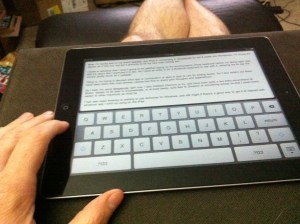
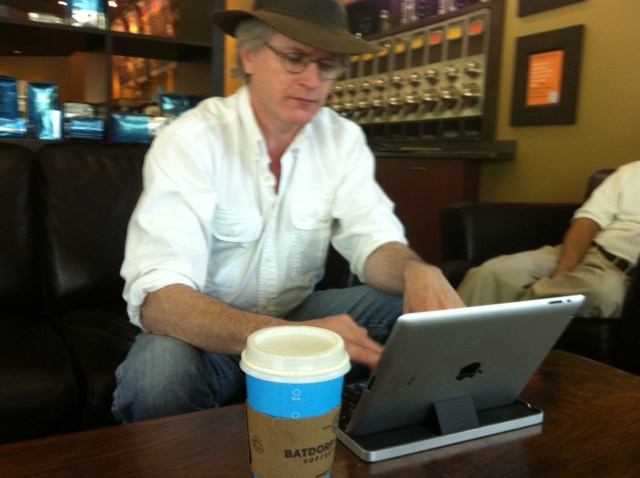
Now, I’m typing this on my brand spankin’ new iPad 2, composing in Simplenote for cut & paste into WordPress. I’m loving the device as a new toy, but got it primarily to be my new main writing tool.

I knew in advance that I wasn’t going to be satisfied typing on the touchscreen’s virtual keyboard (which I’m doing right now, and it’s about like I expected it to be). So I have an order in for a Bluetooth keyboard to use with it, allowing me to use the combo pretty much as a netbook.

Thing is, I’m trying to decide what app or combination of apps is best to use for writing books. So if any writers out there have been down this road already, please feel free to share your thoughts and experiences.

As I said, I’m using Simplenote right now. I also installed Plaintext to try, and have seen quite a few folks recommend IA Writer. Ideally I’d be able to automatically, or at least easily, sync files to Dropbox or something similar so that I could freely switch to other machines as need be. In that vein, I’m curious about DocsToGo as well.

I had also been thinking of starting to use Scrivener for Windows, and still might if there’s a good way to get it to interact with whatever app I wind up using on the iPad.

Again, if you have any experience with this stuff, please share.

Thinking About Writing

Tim Byrd

I’m thinking about writing today.

Not that that’s anything unusual. I think about writing all the time. I think about writing a hell of a lot more than I actually write, which is a big part of the reason there’s not more cool Tim books in the world for you to enjoy, and for me to make grocery money from.

Today, though, I’m engaging in the sort of thinking about writing which is about how best to approach the work, as opposed to what the work should be. Thinking about how to actually organize my self and my space and my time to attain some level of regular productivity, so I can more reliably share the tales I want so much to tell.

I’ve written here a few times about my attempts at getting on a daily schedule, writing so many words a day, every day, and keeping at it. One enormous complication is my depression, which wears huge fucking cleated boots it uses to regularly stomp me into the floor and crush whatever dreams I’m currently dreaming. I’ve written about my struggles with it a few times, so if you’re curious, just click on the appropriate “Depression” category in the sidebar to find those posts.

Today, we’re gonna go with the assumption that I will overcome that hobnailed monster, and focus on what I need to do to best accomplish the work. Continue reading

Malaprop 4: Wrath of the Malapro

“Don and Katy watched hypnotically Gino place more coffees out at another table with supreme balance.”

The usual mandate of my Malaprop posts is to share bits of bad writing I gather from sources all over the place (usually the net), ranging from the rabid comments sections of the blogosphere to the esteemed pages of the New York Times. I tend also to focus mainly on instances where people misuse words or phrases, like writing “they were chomping at the bent” instead of “they were champing at the bit.” Awful spelling, grammar, and generally fucked-up writing are all too easy to find on the web, so I don’t bother calling attention to them.

I also don’t source the screw-ups, as I’m not really trying to target anybody specifically for their errors.

Today, however, we have a very special episode of Malaprop. I will be showing you the latest batch of culls, of course (including a clever use of the word “armature” I got a kick out of), but also I’d like to introduce you to our first malapro, writer Jacqueline Howett.

Ms. Howett is a human being, and obviously a very emotional one, so I’m going to try to be as kind as I can…though simply sharing any of her writing (like the tidbit atop this post) and discussing her behavior is, in itself, gonna be innately rough on her. But I think discussing her is valuable because she’s a stark object lesson for any writers out there (or, really, artists of any ilk) in how not to act. Continue reading

The Future of Publishing

This video, from DK Publishing, is genius.

It’s essential to watch the whole thing.

Malaprop 3: The Ironing

(Read Malaprop 1Read Malaprop 2…)

The time feels right for another installment of my Malaprop series, in which I share some delightful literature I’ve snipped from hither and thither on the net…

Can you spot all the errors? Continue reading

Malaprop 2: The Reckoning

NO! NO! PLEASE...PLEASE WRITE CORRECTLY!!!

Go to  Malaprop 1.

Last week, I shared some of my collection of malaprops, little bits of communications gone awry. I’ve been gathering this material for a while and am sharing it in doses so as not to fry too many of your brain cells all at once.

Time for some more.

One note: I had someone call me out on the tone of the first post, and upon reflection I overplayed the whole “idiot” thing. Some of these errors are from idiots, I’m sure, but many of them are not. They’re just mistakes in language perfectly intelligent folks have picked up without realizing. My rhetoric was meant in fun more than it was meant to antagonize or belittle.

Except when it comes to the real idiots. Screw them.

Now on with the show… Continue reading

Malaprop

I enjoy idiots, up to a point. Watching something like Fox & Friends can be as humorous as watching an old Three Stooges short, if less intellectually stimulating. But only up to a point.

(Hilariously, as I started writing this, Green Day’s song “American Idiot” started up on the random playlist I’m listening to).

But I wish the idiots weren’t so prevalent, particularly at the voting booth, but also on the Internet. As a writer, a reader, a person who values clear thought and knowledge, and an educated guy, I’m often appalled at what I see passing for communication among my fellow citizens.

A while back, I started collecting bits of idiocy I came across online. Now, I’m not talking about net-speak or texting shortcuts, or even persistent spelling stupidities like using “villian” instead of “villain.” I’m talking about people using words and phrases that don’t work the way they think they do.

I haven’t bothered sourcing these. My intent isn’t to embarrass anyone specifically. But my sources range from comments left on blog posts here and there all the way up to the Gray Lady herself, The New York Times.

I haven’t bothered with anything from the brain of George W. Bush, as the only torture he practiced that was more egregious than that he practiced on human beings was that he practiced on language. He’s in a class all by himself.

I’m going to break my collection up into serialized posts. I’m posting this stuff for two reasons: one, to laugh at the gaffes of those who can’t be bothered to make sure they’re saying what they think they’re saying, and two, to encourage anyone reading to please bother to make sure. Especially if you’re presenting your work as even semi-professional, much less professional, writing.

Now, onward to the flubs and gaffes. Can you identify them all? Continue reading

The Loneliness of the Long Distance Writer

As of today, I am one year late on delivery of my second book.

I’ve been writing lately about my depression and its roots, and about the past year being really rough. Like hanging off the edge of a giant razor blade by your fingers rough.

The manuscript I’m so long overdue on is no great massive volume. I’ve not floundered halfway through my War and Peace. It’s just the second Doc Wilde book, which at editorial decree is to be about the same length as the first, #30-40,000 words. I should’ve been able to write it in a couple of months. That was, indeed, the plan that led to the original deadline.

But, depression. And some major health issues related to it. Continue reading

SKULLDUGGERY (A Free, Serialized Novel by Tim Byrd)

Drogarth.

The name alone conjures dark images of spilling blood, of blackest magiks, of lawlessness and chaos. Throughout the kingdom children hear stories of this evil city and are told they must never go there — and they wish with all their hearts that one day they will. For children are the custodians of wishes, of dreams; they know in their hearts, in their souls, that only in the darkest of pits can the brightest adventures be found…

Years and years ago, when I had a bit more spring in my step and fewer callouses on my heart, I got out of a misguided stint in the U.S. Army and plopped down at a cheap portable typewriter to begin living the life I always intended to live, that of a dashing and prolific novelist.

I was living on savings, shacking up in Kassel, West Germany (there was still an East Germany then) with a wonderful girlfriend named Rike (whom I’d met the very day I’d arrived at my Army post), who was deep in her own university studies while I took the time to write.

It was a happy year. It was the most productive year of my life, too.

First, I wrote a short fantasy adventure novel called The Road to Adventure. It was sort of stock fantasy — knights and elves and hot pagan priestesses — mixed with sheer swashbuckling and quite a bit of eldritch horror. Took me just over a month to write, and I got it in the mail and started the next project.

The Road to Adventure damn near got published too. A senior editor at one of the big science fiction/fantasy publishers took a liking to it and went to bat for it with the editorial board. See, getting a book published isn’t just a matter of getting a “yes,” it’s a matter of getting a series of “yeses,” and if you get a “no” in that series, you’re screwed. According to the editor, I had the majority of folks wanting the book, but got two key noes; I was screwed. But hey, pretty good for the first shot.

Of course, that resolution took a while, during which I wrote my second book. This took a lot longer than a month. Whereas I’d written Road with a detailed outline, I started this one with a setting, a couple of character ideas, and the notion that I was gonna write a “hardboiled fantasy,” mixing standard sword and sorcery tropes with gritty crime fiction. And I had the title:

Skullduggery. A Tale of Thieves. Continue reading

Shane Black On The Writer And Fear

I’ve mentioned Shane Black a few times recently. A friend from years back, he’s also the screenwriter responsible for a few classic flicks, among them Lethal Weapon and Kiss Kiss Bang Bang. Recently, he’s been working on the script for the forthcoming Doc Savage movie.

So Shane knows what it’s like to put bread on the table (and in the bank) by typing words out of your head.

Writer Billy Mernit recently blogged about Shane’s visit to the “Writing the Character-Driven Screenplay” class that Billy’s in. Shane made some comments about writers and fear that are worth reading for anyone facing the sinister blank screen…

I know it’s tough to say, ‘Don’t be afraid,’ or ‘Think positive,’ but…There really is just no other way to go.  You’re up against a wall, you’ve decided you want to do something, you’re having some adversity – you can either play out your hand or quit.  And I suggest that… My career came down to one moment like that.

I was working on a script called Shadow Company in 1984, and I was on page one, and I showed it to my brother – he hated it.  I sat down and I thought, “I can’t do this.  I sat down to write a screenplay – I don’t know screenplays, what am I doing, this is so stupid… And I thought: I don’t want to write!  I don’t want to do this, I can’t.

I’m a one-finger typist.  And I said – Just do it.  [Shane holds his one typing forefinger in the air, and jabs it an invisible keyboard.] I went, ‘The… rain… lashes…  Ground… Bla-bla-blah.  I started typing – I hate this, I hate this, I hate this, I hate this – and all of a sudden, I’m: Huh, okay that’s a good line. What would he say there?  Okay, he says this… And three pages later, I had a scene, and it became a script – and it sold, optioned – and it got me Lethal Weapon.

It came down to this.  I had a piece of paper in a typewriter and my finger poised to hit one key and I couldn’t do it, I didn’t want to do it all.  All I wanted to do was stop.  And I hit the key.  And now I have a career.  So that’s the leap of faith.

The whole piece is here.

The War of Art

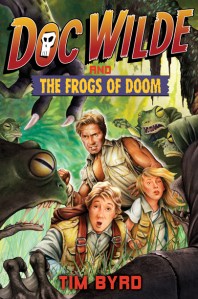
In my advice to writers, there are two books I always recommend. One is On Writing by Stephen King, the other is The War of Art by Steven Pressfield. Immediately after I first read the latter, I plopped down and wrote my first novel, Doc Wilde and The Frogs of Doom, and I re-read it regularly (easy to do, as it’s a short book).

Pressfield’s deal is getting us to overcome the resistances within ourselves and just getting down to the friggin’ work. His book is a self-help book that’s really helpful and not full of homilies and crap like “You are the captain of your own ship.”

(Which a therapist once told me in what was, inevitably, our one and only session because I damn near laughed in her face).

I recently became aware of Pressfield’s blog for writers, Writing Wednesdays, and it should be required reading for anyone wanting to make it in the arts.

Here’s one gem I found there:

The Muse, if she’ll forgive me, is kind of like a mailman. She makes her rounds every day, cruising past our offices and studios and peeking in the window. Are we there at our easels? The Muse likes that. She likes to see us taking care of business. And if we’re there with our hearts breaking or tears streaming down our cheeks, all the better. The Muse says to herself, “This poor bastard is true to me; I’m gonna give him something in return for his loyalty.”

And into our heads pops the solution to Act Two, the bridge to that song we couldn’t lick, the breakthrough concept for our new philanthropic venture.

The lesson is, if you’re not at the place you do the work, at least trying to do the work, the work won’t happen. And if you are there, and getting down to business, you will discover wondrous things, gifts from the Muse, that will surprise you and enrich both you and the work itself.

But you’ve gotta be working for it to work.

Why I Will NOT Read Your Stuff

“Do these jeans make me look fat?”

That’s the classic relationship question that has only one answer, unless you want to hurt the asker’s feelings. And largely, the asker wants that one answer. The reassurance. They’re not really looking for the asked to use their critical eye, not wanting raw, unflinching honesty.

This, precisely, is how the overwhelming majority of wannabe writers/artists/musicians ask for critique of their work. Continue reading

The Truth About Publishing (Required Reading for Writers)

For the writers among you, or anyone just curious about all the ins-and-outs of the publishing business, I highly recommend a longish essay called “The Truth About Publishing” by Australian writer Ian Irvine.

It’s very comprehensive, and I’m not too proud to say I learned a lot from it that I didn’t know.

Here’s Ian on the statistical odds of getting a book published: Continue reading

A Children’s Author Ponders Doc Wilde

docwilde1

Order Now!

Children’s author Gail Gauthier read Doc Wilde and The Frogs of Doom and offered up some interesting thoughts about it on her blog. She seems to have had trouble pigeonholing it as she read the first part of the story: Continue reading

Read An Excerpt From DOC WILDE & THE FROGS OF DOOM At The New Doc Wilde Site!!!

docwilde

For a while, I’ve been using a subpage of this blog as the official site for Doc Wilde, but I’ve now launched a more respectable site that has much more to offer, including a free excerpt from my novel Doc Wilde and The Frogs of Doom.

Head over to www.DocWilde.com to join the adventure.

Timformation

Tim Byrd

Tim Byrd

There are several ways to get all the Timformation you need. This site, www.tim-byrd.com, home of my blog Under An Outlaw Moon, is of course one of them.

Here are some others, and more will likely follow:

Tim on Facebook

Tim on MySpace

Tim on Twitter

Tim on Goodreads

Tim on Amazon

Feel free to contact me through any of these sites, or through a comment on the blog. I’m friendly and rarely bite, though I am very busy being a dad and a writer and may not always be as prompt in replying as I’d like.

Also, no, I won’t read your story, novel, idea, diary, outline, fortune, pie chart, autobiography, recipe, or the bumps on your head. I’m bogged down in research, way behind on personal reading, generally even more behind in my daily life, and have been strongly advised not to look at other’s unpublished work for several solid legal reasons.

I am going to try to share any and all wisdom I may gain as a professional writer through this site, though that wisdom is rather slim so far. The main advice I can give is this:

“Write it. Then send it out till someone buys it. Till they do, write something else and send it out. Repeat.”

It’s as easy as that. And as difficult.

[NOTE: This info is replicated for permament reference on its own page, accessible through the menu bar down the right side of this page.]

Writing Tips From Joss Whedon

Danny Stack at his “Scriptwriting in the U.K.” blog offers up “Joss Whedon’s Anatomy of a Screenplay,” a short piece originally published in 4Talent magazine. As Joss is one of the living gods of Story Itself, I am always willing and eager to absorb any wisdom that trickles down from his pad on Olympus (or his Olympus typewriter, maybe, which would be a cool bit of godlike wisdom product placement, except he probably writes on a computer like the rest of us schlubs, so damn). (But then again, his pad on Olympus, that’s not bad, because it can be his domicile, but it can also be his writing pad, which is something he probably does still use, even in this digital age, so hey, that works, right…right? Damnit, I need coffee. Or something.).

Anyway.

The piece is basically Joss’s ten tips for screenwriters (with a slight emphasis on script-doctoring, which is hiring on to touch up someone else’s script). I love the fact that Step 1 is “Finish It,” and my favorite bit of advice is #9:

Having given the advice about listening, I have to give the opposite advice, because ultimately the best work comes when somebody’s fucked the system; done the unexpected and let their own personal voice into the machine that is moviemaking. Choose your battles. You wouldn’t get Paul Thomas Anderson, or Wes Anderson, or any of these guys if all moviemaking was completely cookie-cutter. But the process drives you in that direction; it’s a homogenising process, and you have to fight that a bit. There was a point while we were making Firefly when I asked the network not to pick it up: they’d started talking about a different show.

The fact that this is my favorite bit would probably come as no shock to my editor (though I listened to him waaaaay more than I didn’t, and the book is better for it).

Go here for the full piece: http://dannystack.blogspot.com/2009/01/joss-whedons-top-10-writing-tips.html