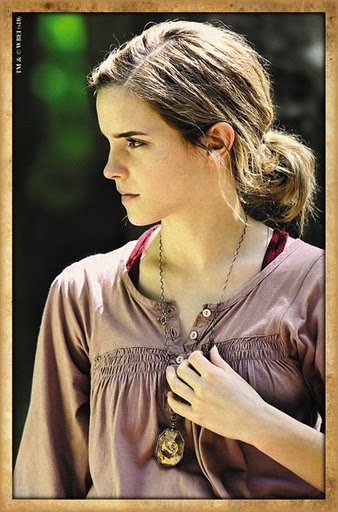
Haven’t seen Harry Potter and The Deathly Hallows yet, but have read all the books. But I had this short dialogue on Facebook with writer Alex Wells in which I shared some thoughts I’d had when I read Hallows:

Haven’t seen Harry Potter and The Deathly Hallows yet, but have read all the books. But I had this short dialogue on Facebook with writer Alex Wells in which I shared some thoughts I’d had when I read Hallows:
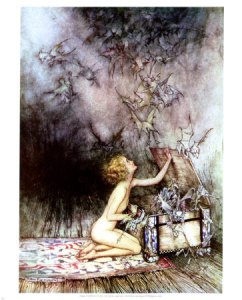
I want to share with you an incredible poem by novelist/poet Francesca Lia Block, who I just met but think, somehow, I’ve always known.
In this poem, she builds a dark fairy story explicitly on the framework of Vladimir Propp’s folk tale morphology with powerful, exquisite results.
Here’s a taste, click here for the whole thing.
ABSENTATION: How could I have left them? The boy with his small, fierce body. The girl with lupine eyes. They stood weeping in the doorway between the light house and the night. Their warmth still lingered on my cold hands even after I was gone.
INTERDICTION: “Don’t go!” they wailed. “Don’t go with him.” They ran to the window and watched me get into the long black car. I saw their faces shining there, like little lights. Like stars reflected in the dark pool of the glass. He was hunched over the wheel and wore a ruffled shirt. His eyes were an interdiction, too but I did not recognize.
VIOLATION of INTERDICTION: He carried me away into the night. Trees bloomed in the fluorescence and strange electronic birds sang. He picked a flower and put it behind my ear and read me poetry. I swooned. It did not take much.
RECONNAISSANCE: We went to find my mother in a weird old restaurant that smelled of meat. She was sitting fragile in a huge red booth like a piece of garnish. She, too, was tricked by him. She took me aside and said, No other man has deserved you yet, my darling.
DELIVERY: Where is the cancer? he asked her. She told him and he laid his hands on her as if he were a healer. We gasped with gratitude and relief. How little we knew him…
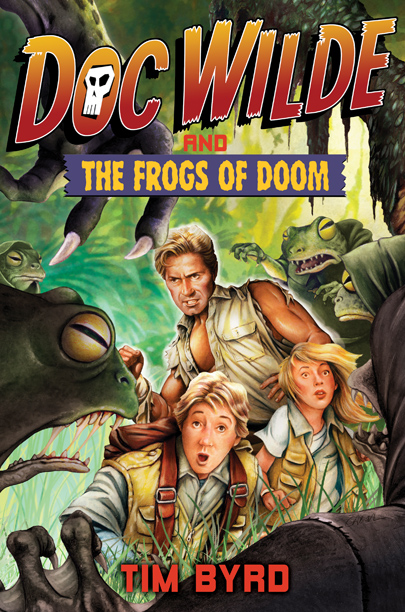
I’m not sure why, but Amazon currently has some marked down copies of my pulp adventure novel, Doc Wilde and The Frogs of Doom, selling for just $6.23.
Buy Now!
This is a first edition hardback (the paperback is due out next year), and the cover price is $15.99. Amazon is also offering it at a discounted $12.47.
Considering that the hardback usually runs $11 to $16, and the paperback when it finally comes out will likely be a minimum of $8, this is a great opportunity to get the book for cheap.
For the uninitiated, Doc Wilde is my modern take on the great old adventure tales featuring characters like Indiana Jones, The Shadow, the Spider, and most importantly Doc Savage, with strong currents of H.P. Lovecraft’s eldritch horror swirled in.
It is published as a book for young teen readers, but like something like Raiders of the Lost Ark or The Incredibles, is intended for both young and old.
Frogs of Doom is the first in a series; next will be Doc Wilde and The Mad Skull.
You can check out some reviews at http://www.docwilde.com/reviews/.
I reported a while back that my old friend Shane Black (writer of Lethal Weapon among other things) was scripting a Doc Savage movie. As many of the folks who’d care most about this sort of thing likely already know, it was recently confirmed that not only is Shane writing the screenplay (along with Anthony Bagarozzi and Chuck Mondry), he will be directing the film as well. Anyone who has seen Shane’s directorial debut, Kiss Kiss Bang Bang, will know how exciting this news really is.
With Sam Raimi working on The Shadow, it’s looking very promising for pulp adventure in the near future. Now all we need is a Bruce Timm adaptation of Doc Wilde and the world will truly be on the right track.
In related news, DC Comics just released the first issue of their First Wave series, in which they establish an alternate world, outside the normal DC universe, in which pulp heroes operate, and no one has super-powers. The greatest of the heroes in this world is, of course, Doc Savage.
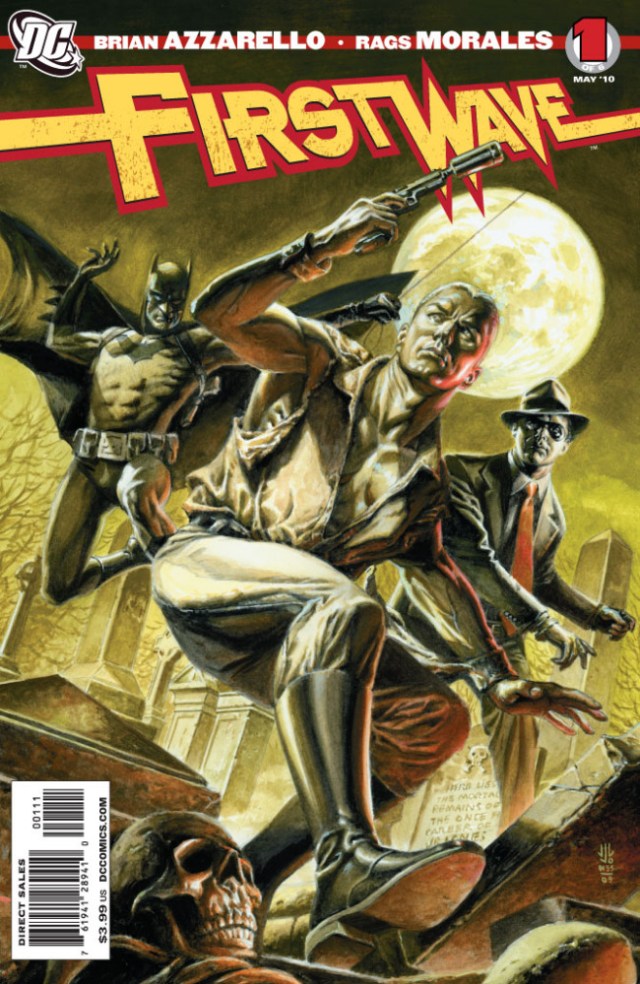
The First Wave series actually began last year with the one-shot Batman/Doc Savage special I reviewed in November. I was underwhelmed, but still hopeful that the actual series would be good.
Well, I just read First Wave #1, and it’s awesome pulp and awesome comics. Brian Azzarello’s writing and treatment of these classic characters honors their roots while at the same time deepening their emotional lives and rooting them realistically into the world. And artist Rags Morales brings the cast to vivid life with a style that’s both realistic and somewhat cartoony, befitting the pulp nature of the work. My only beef with the book is that Doc Savage’s hair color and complexion are still off, though not as badly as they were in the Batman team-up book.
Great stuff.
Years and years ago, when I had a bit more spring in my step and fewer callouses on my heart, I got out of a misguided stint in the U.S. Army and plopped down at a cheap portable typewriter to begin living the life I always intended to live, that of a dashing and prolific novelist.
I was living on savings, shacking up in Kassel, West Germany (there was still an East Germany then) with a wonderful girlfriend named Rike (whom I’d met the very day I’d arrived at my Army post), who was deep in her own university studies while I took the time to write.
It was a happy year. It was the most productive year of my life, too.
First, I wrote a short fantasy adventure novel called The Road to Adventure. It was sort of stock fantasy — knights and elves and hot pagan priestesses — mixed with sheer swashbuckling and quite a bit of eldritch horror. Took me just over a month to write, and I got it in the mail and started the next project.
The Road to Adventure damn near got published too. A senior editor at one of the big science fiction/fantasy publishers took a liking to it and went to bat for it with the editorial board. See, getting a book published isn’t just a matter of getting a “yes,” it’s a matter of getting a series of “yeses,” and if you get a “no” in that series, you’re screwed. According to the editor, I had the majority of folks wanting the book, but got two key noes; I was screwed. But hey, pretty good for the first shot.
Of course, that resolution took a while, during which I wrote my second book. This took a lot longer than a month. Whereas I’d written Road with a detailed outline, I started this one with a setting, a couple of character ideas, and the notion that I was gonna write a “hardboiled fantasy,” mixing standard sword and sorcery tropes with gritty crime fiction. And I had the title:
Skullduggery. A Tale of Thieves. Continue reading
No one, not even me, ever knew my father’s first name.
Everyone always just referred to him by his last name, in classic tough guy style, and my dad was definitely a tough guy. Yet he was no thug, no bully, but a protector of those that needed protecting. A warrior, as defined by ninja Shihan Jack Hoban is “a man of action, guided by reason, and motivated by love,” and that was my father through and through.
My last name is Byrd. But that wasn’t my father’s last name. His was Spenser. And if you needed help, he was for hire.
Spenser wasn’t my real father, alas. He wasn’t even actually real. He was a character in thirty-nine novels by Boston novelist Robert B. Parker, who died of a heart attack while writing the morning of January 18th, 2010. He was 77.
So why do I claim Spenser as my dad? Continue reading
Buy Now!
In May, my first book finally came out to great reviews and sales good enough to get Putnam to contract me for the next two books in the series. An adventure inspired by the pulps of the 1930s, I intended it for both kids and adult readers. Gratifyingly, it has done quite well with both.
For those uninitiated in the adventures of the family Wilde, you can find loads of info (and an excerpt) at www.DocWilde.com.
Elizabeth Bird is one of the most respected reviewers associated with Publishers Weekly, and was one of the critics I went out of my way to try to get to review my book, Doc Wilde and The Frogs of Doom. I read her blog regularly and enjoy her insights, and looked forward to seeing what she had to say about my fledgling effort.
Well, months passed, and the magazine seemed unaware of the book, and it didn’t appear on her blog. I’d pretty much given up on ever seeing anything from her, or PW, but then she posted an entry in which she gave tiny reviews of a bunch of books she’d read last year but hadn’t gotten around to reviewing.
This is what she said about my book:
Doc Wilde and the Frogs of Doom by Tim Byrd – I appreciated how the book just leapt headfirst into the action, catching readers up after the fact, and also how I can now hand kids something when they come asking me for books “Just like Indiana Jones” (which really does happen).
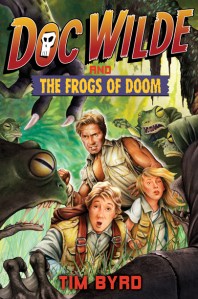
Buy Now!
A review of Doc Wilde and The Frogs of Doom over at Curled Up With a Good Kid’s Book:
A true tale of adventure, this book takes off at break-neck speed and never slows down. Doc Wilde is a golden hero, of the type we haven’t seen since Flash Gordon (in the Buster Crabbe version) faced off with Ming the Merciless. Brian and Wren, young though they are, use their wits and their innate sense of justice to stand beside their father all the way. They’re the kind of sidekicks that comic book superheroes can only dream of finding, and they are certainly a credit to the Wilde family with its history of outlandish exploits and fair-minded pursuits.
The rest is here.
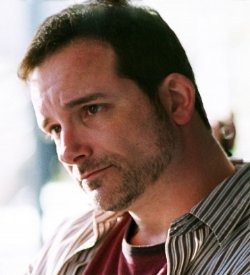
I’ve mentioned Shane Black a few times recently. A friend from years back, he’s also the screenwriter responsible for a few classic flicks, among them Lethal Weapon and Kiss Kiss Bang Bang. Recently, he’s been working on the script for the forthcoming Doc Savage movie.
So Shane knows what it’s like to put bread on the table (and in the bank) by typing words out of your head.
Writer Billy Mernit recently blogged about Shane’s visit to the “Writing the Character-Driven Screenplay” class that Billy’s in. Shane made some comments about writers and fear that are worth reading for anyone facing the sinister blank screen…
I know it’s tough to say, ‘Don’t be afraid,’ or ‘Think positive,’ but…There really is just no other way to go. You’re up against a wall, you’ve decided you want to do something, you’re having some adversity – you can either play out your hand or quit. And I suggest that… My career came down to one moment like that.
I was working on a script called Shadow Company in 1984, and I was on page one, and I showed it to my brother – he hated it. I sat down and I thought, “I can’t do this. I sat down to write a screenplay – I don’t know screenplays, what am I doing, this is so stupid… And I thought: I don’t want to write! I don’t want to do this, I can’t.
I’m a one-finger typist. And I said – Just do it. [Shane holds his one typing forefinger in the air, and jabs it an invisible keyboard.] I went, ‘The… rain… lashes… Ground… Bla-bla-blah. I started typing – I hate this, I hate this, I hate this, I hate this – and all of a sudden, I’m: Huh, okay that’s a good line. What would he say there? Okay, he says this… And three pages later, I had a scene, and it became a script – and it sold, optioned – and it got me Lethal Weapon.
It came down to this. I had a piece of paper in a typewriter and my finger poised to hit one key and I couldn’t do it, I didn’t want to do it all. All I wanted to do was stop. And I hit the key. And now I have a career. So that’s the leap of faith.
The whole piece is here.
Buy Now!
The Saturday before Christmas (December 19, 2009, from 3-5 pm), I’m going to be at Eagle Eye Bookshop in Decatur, GA for a reading/discussion and book signing. Eagle Eye is a fantastic indie bookstore, well known for its author events.
It being the Yule, I figured I’d do something special. So instead of just doing the usual reading from Doc Wilde and The Frogs of Doom, the first book in the series, I’ll be reading the opening chapters of the second book, Doc Wilde and The Mad Skull, which will see print a while down the line.
This will be a rare opportunity to get a peek at a book that’s still being written, prior to any editorial input. First draft pulp, straight from my swashbuckling brain pulp.
Afterward, there’ll be a casual discussion about the book(s) and I’ll be signing Frogs of Doom. Which is not only a fun pulp adventure tale for kids and adults, but a FANTASTIC holiday gift. ;)
Over at Goodreads, the Pulp Magazine Authors and Literature Fans group is discussing my book, Doc Wilde and The Frogs of Doom (it was the official common read for November, but the discussion is only really just beginning).
I’d like to invite any and all of you to join in, or at least hop by and take a peek:
Pulp Magazine Authors & Literature Fans Home Page
“Common Reads” Discussion Board
If you’re a reader and you’re not taking advantage of Goodreads, you should be. It’s a great site for sharing and discovering books, and there’s a lot of dialogue between not only readers and other readers, but readers and writers.
Recently, I blogged about Earth2.net’s podcast of the Doc Savage radio adaptation NPR did back in the eighties. At the time of my post, only chapters 1 & 2 (of seven) had been broadcast.
They’ve now broadcast the entirety of the story, and I’ve updated the pertinent post with all the links: original post.
Buy Now!
The latest review of Doc Wilde and The Frogs of Doom is from author Kevin Gerard at fantasyfan.org:
I became a kid again after reading three pages of this story. When we were young, all of us watched the biggest cartoon show on television – Johnny Quest. Johnny traveled the world with his father, Dr. Benton Quest, a guy who knew everything, could make anything, and never settled for failure.
Dr. Spartacus Wilde makes Dr. Quest look like the kid with the dunce cap in the corner of the classroom.
The full review is here.
The September 1934 issue of Doc Savage Magazine offered an action-packed tale called Fear Cay, which in addition to being a solid pulp adventure also featured the second appearance of Doc’s gorgeous and daring young cousin, Patricia. (I recently reread the tale as I got into the right mood to write the next Doc Wilde novel for Putnam).
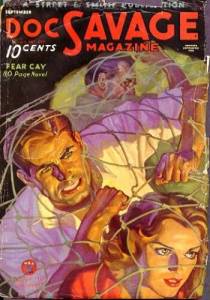
In 1985, NPR produced serialized radio plays based on two of the Doc Savage novels, The Thousand-Headed Man and Fear Cay (which they renamed Fear Key, assuming, I guess, that people these days are too stupid to figure out what a “cay” is). These radio plays were very well done and a lot of fun, and are really tough to get hold of these days.
The web radio show Earth-2.net’s most recent podcast features the first two chapters of Fear Key. If you’re a fan of the Man of Bronze, or curious about him and his adventures, it’s worth a listen. Hopefully they’ll be running the remaining five chapters, but if they don’t, I think I have them on some hard drive somewhere and I’ll post them if anyone wants.
Hear the adventure here.
UPDATE: They have now posted the rest of the chapters of the show. The link above is to chapters 1-2, this link is to chapters 3-4, and this link is to chapters 5-7.]
So I just finished reading DC’s Batman/Doc Savage Special, which I’ve been looking forward to for a while.
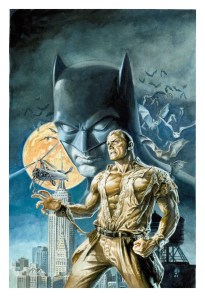 Great cover by J.G. Jones. Inside…hmm.
As a prologue leading into the pulpy First Wave books DC will start publishing next year, it works fairly well in establishing the alternate universe in which these characters coexist. As a story, it kinda fails. Writer Brian Azzarello brings a noirish attitude to it, and gives an interesting take on the heroes, but narratively it just hangs limply and ends on a trite note.
It’s not helped by the artwork by Phil Noto, which lacks the visual dynamism that comic book storytelling really demands, and the book’s color palate (I assume colored by Noto himself, as no credit is given otherwise) is dreary in an obvious attempt at making it feel more noir. It just makes it seem unexciting.
And I really don’t like Noto’s take on Doc Savage, especially the coloring he’s given.
All that said, I’m still looking forward to seeing what they do with First Wave, though with more trepidation. It will feature art by Rags Morales, and the advance images that have been shown are great, a lot better than the art in the comic at hand.
Also, I have to say, in spite of the underwhelming story in this book, I’m intrigued by Azzarello’s comments and notes about the various heroes who will be operating in this pulp, non-superpowered world. He has clearly studied the original characters in depth and put a lot of thought into fleshing them out psychologically and making them somewhat more realistic than might usually be the case. I’ve seen a few comments by devoted pulp fans who detest this approach to the classic characters they love, but I like well-developed characters, and at least in principle I find Azzarello’s ideas pretty cool.
My main reservation along those lines is that, if this comic is any indication, he may have too much noir and not enough pulp adventure in his approach. This could work fine for Batman, but not for characters like Doc Savage, who really need to be somewhat over the top. More realistic I can enjoy. Mundane, not so much.
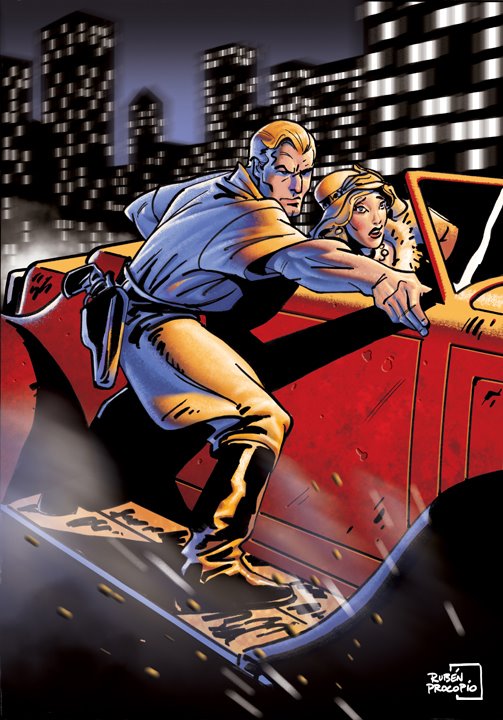
Art by Ruben Procopio
It’s no secret that Doc Savage, Lester Dent’s pulp hero from the 1930s and 40s, is a huge inspiration for my own character, Dr. Spartacus Wilde (who saves the Earth from Lovecraftian batrachia in Doc Wilde and The Frogs of Doom). I grew up on paperback reprints of the Doc Savage novels and they, along with other pulp sources I’ve written about, are strong strands of my literary DNA.
In fact, Grandpa Wilde (Spartacus’s father), the original Doc Wilde who was famous in the thirties and forties, is my intertextual acknowledgment that the original hero is parent to the current hero, but also speaks to the fact that the younger Wilde is his own man. As similar as he is to Savage, he is also very different in ways, not least of which is that he is a warm, emotionally accessible family man, unlike the stern and remote man of bronze.
Unlike The Shadow, the only character more popular during the pulp era, Doc Savage isn’t very well known these days, though his influence on characters ranging from Batman to James Bond is widespread. But there are still quite a few fans, many having grown up on the same books I did. One of them is Shane Black. Continue reading
I just came across the latest review of my book, Doc Wilde and The Frogs of Doom, and it’s from someone who knows ’em some pulp.
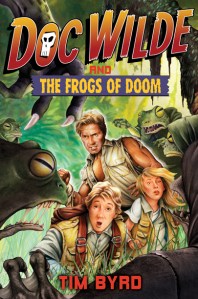
Order Now!
Back in March, I blogged about some oddly inspiring material I found in a new roleplaying game I’d bought (Optimism, Action, and How To Be The Neighborhood Pulp Hero). The text in question “caused a synaptic hiccup and made me think about my life.” Pretty darn cool for a game manual.
The game, Spirit of the Century, is not only the best-by-far pulp game I’ve ever found (and I know most of them, all the way back to the first, 1982’s Daredevils from Fantasy Games Unlimited), it’s quite possibly the greatest face-to-face rpg. I’m reserving final judgment till after I actually have time to play the game, at which time it’ll get a full review here.
My copy of SotC had some issues, alas, but Fred Hicks, one of the game’s co-authors, exhibited some first class customer service and sent me a new copy. These are truly good guys in an industry with an often razor-thin profit margin. I was greatly appreciative at this, so I sent him a signed copy of my book.
Well, apparently Fred read the book, because on October 20th, he gave it a quick review on his blog.
While set in the modern day, this book LOVES pulp (and Lovecraft, for that matter) and makes a bunch of oblique and not so oblique references to it throughout. It’s a breezy, very fast read for an adult, but an adult will be entertained precisely because of those references. It’s like a fast mad dash through a landscape littered with mines that explode with geek-love every now and again.
To summarize the plot would be to tell the story of the whole book, so I’m going to leave that out of this. It’s a fun family romp, has good life lessons for kids, and features a boy child and a girl child who both compete with each other and value each other…And if you’re looking to get your kids primed with some excitement about high-pulp adventure…I think Doc Wilde would be a handy tool for giving that to ’em…
There’s a bit more, which can be found here.
In my advice to writers, there are two books I always recommend. One is On Writing by Stephen King, the other is The War of Art by Steven Pressfield. Immediately after I first read the latter, I plopped down and wrote my first novel, Doc Wilde and The Frogs of Doom, and I re-read it regularly (easy to do, as it’s a short book).
Pressfield’s deal is getting us to overcome the resistances within ourselves and just getting down to the friggin’ work. His book is a self-help book that’s really helpful and not full of homilies and crap like “You are the captain of your own ship.”
(Which a therapist once told me in what was, inevitably, our one and only session because I damn near laughed in her face).
I recently became aware of Pressfield’s blog for writers, Writing Wednesdays, and it should be required reading for anyone wanting to make it in the arts.
Here’s one gem I found there:
The Muse, if she’ll forgive me, is kind of like a mailman. She makes her rounds every day, cruising past our offices and studios and peeking in the window. Are we there at our easels? The Muse likes that. She likes to see us taking care of business. And if we’re there with our hearts breaking or tears streaming down our cheeks, all the better. The Muse says to herself, “This poor bastard is true to me; I’m gonna give him something in return for his loyalty.”
And into our heads pops the solution to Act Two, the bridge to that song we couldn’t lick, the breakthrough concept for our new philanthropic venture.
The lesson is, if you’re not at the place you do the work, at least trying to do the work, the work won’t happen. And if you are there, and getting down to business, you will discover wondrous things, gifts from the Muse, that will surprise you and enrich both you and the work itself.
But you’ve gotta be working for it to work.
I conceived of the adventures of Doc, Wren, and Brian Wilde as a series, starting with Doc Wilde and The Frogs of Doom. That was the plan. As a writer, I decided, I am in the Doc Wilde business.
Putnam also saw the Wildes as a potential series, but largely avoided talking about that. They are, after all, a business. Profits must be made, books must be balanced. So they understandably played it close to the vest, waiting to see how Frogs of Doom did, both critically and commercially.
I kept with my plan, continuing to work on Wilde stuff, figuring that even if Putnam ultimately didn’t opt to publish more, I’d find some way to get these adventures out there.
As anyone who’s been following the reviews of the book knows, the Wildes have been extremely well received by the critics. I literally had one sort of negative review, and even it largely praised the book, though it wasn’t the writer’s cup of tea. Even Kirkus Reviews, which is notoriously tough, had only good things to say (Novelist Kimberly Derting commented “I’m awed, you’ve cracked the Kirkus code!”)
(Feel free to visit the Reviews page at the Doc Wilde website.)
As for sales… Continue reading
 Under An Outlaw Moon